

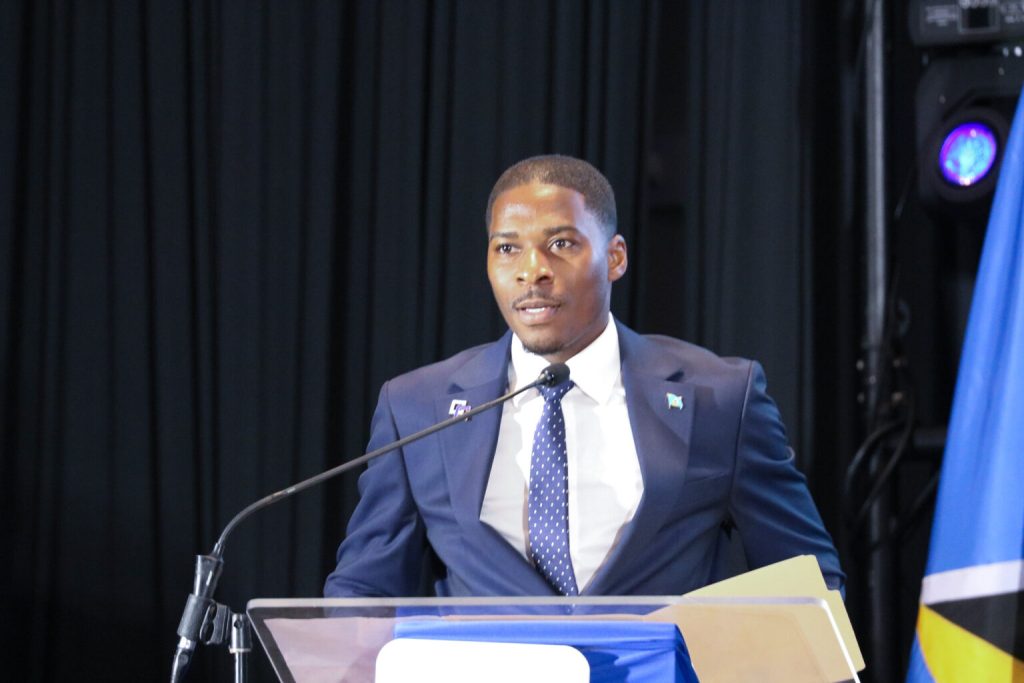
The 51st Regular Meeting of the Conference of Heads of Government of the Caribbean Community (CARICOM) officially opened on Sunday, July 5, at Sandals Grande, Gros Islet, with Prime Minister Philip J Pierre assuming the chairmanship of the regional bloc for the next six months.
As regional leaders gathered to chart the Community’s future, the ceremony’s feature a youth advocate and law student Rahym Augustin-Joseph, delivered a passionate address urging CARICOM to move beyond declarations and focus on implementing solutions that produce tangible benefits for Caribbean people.
Augustin-Joseph said the region faces mounting global pressures, from shifting geopolitical dynamics to migration, conflict and climate change, making stronger regional integration more critical than ever.
“But in this changing world, we see a biting bluntness, where superpowers attempt to reassert colonial hierarchies with the lingos of first and only and other terminologies,” he said.
He also pointed to global immigration policies and international conflicts that continue to affect Caribbean societies.
“Whether it be the anti-immigration policies sending our godfathers and grandparents back to this region, or wars in the east, or climate change, where believe you me, it is the only source where you get more than you put in.”
Quoting University of the West Indies Principal Professor Justin Robinson, Augustin-Joseph reminded leaders that the region must rely on its own strength.
“Professor Justin Robinson of the UWI said it better than I ever could. And he said that no one is coming to save us. And it means therefore, we must believe in our capacity to save ourselves.”
Despite acknowledging the challenges confronting the Caribbean, he insisted there remains reason for optimism.
“I’m not preaching diclinism. I’m not preaching despair,” he said. “In fact, I deeply associate myself with the Gramscian notion of the optimism of the will, despite the pessimists of the intellect.”
He argued that CARICOM has reached a defining moment in its history.
“CARICOM can no longer have the luxury of time. We do not have the moment. We do not have the privilege to ensure to be cynical. And nor do we have the resources to put our hands up in despair.”
“And therefore, CARICOM is no longer optional. It is no longer idealistic. It is therefore existential. And if ever there was a time to integrate, it is now.”
The young speaker also described Saint Lucia as an appropriate venue for discussions on regional renewal, pointing to the country’s historical contribution to Caribbean integration.
“The good news is that if ever there was a place for renewal, it has to be Saint Lucia,” he said, citing the legacy of Nobel Laureates Sir Arthur Lewis and Sir Derek Walcott.
He recalled Walcott’s vision of Caribbean identity, saying the celebrated poet reminded the region that “the Caribbean need not be a subject of somebody else’s story.”
Turning to CARICOM’s internal challenges, Augustin-Joseph argued that the Community’s greatest weakness is not a shortage of ideas but a failure to implement decisions.
“We must overcome the implementation deficit disorder, which has caused a litany of community decisions to never be transformed within our local institutions,” he said.
“The Achilles heel of this integration movement is not a deficit of ideas. There is not a single issue within this region that this integration movement has not pronounced upon.”
Instead, he challenged leaders to identify the reasons implementation continues to fall short.
“The problem, however, is that the issue affecting this region is that we, one, have not been able to ask the difficult question of why implementation fails. Is it political will? Is it technical capacity? Is it a lack of political stakeholder buy-in?”
Rather than announcing ambitious initiatives that may never materialize, he urged leaders to priorities practical achievements.
“I ask you to not overly promise the most ambitious plans after the next few days but focus on a few transformational low-hanging fruits that for decades have humbugged this institution.”
Among his priorities was the long-standing issue of freedom of movement across the Caribbean.
“We must realize the full freedom of movement within this region,” he said. “To do that, you must fix the regional transport system. We must remove the duplicity of the processes and the qualifications in our skills certificates. We must ensure uniformity and harmony. We must bring new qualification schemes in line with our changing education and vocational training.”
He also called for renewed attention to the CARICOM Charter of Civil Society and improved incentives for returning Caribbean nationals.
“We must look at the charter of civil society properly and assess its justiciability. And we must create a new incentive regime for the returning Caribbean nationals to be able to integrate fully within this region.”
Prime Minister Pierre will serve as Chairman of CARICOM until December 1, 2026, overseeing the regional body’s work on economic development, climate resilience, security and deeper Caribbean integration.