

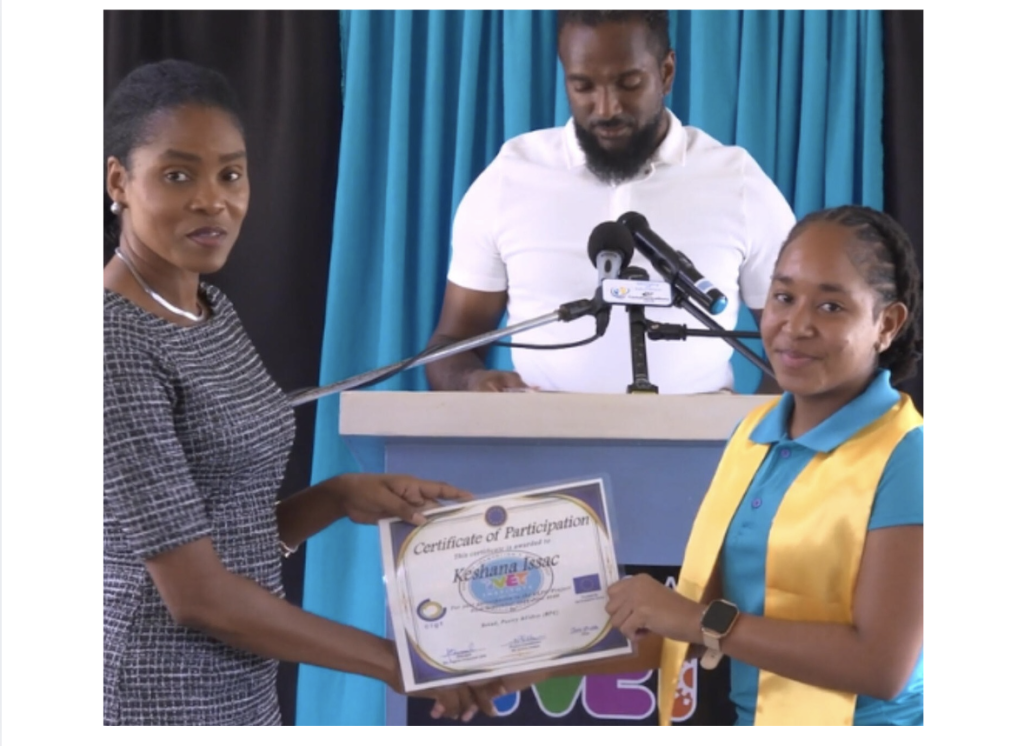
A two-year technical and vocational education and training (TVET) initiative aimed at strengthening practical skills among students has officially concluded with a graduation ceremony and exhibition at the School of Innovation and Technology in Anse Ger this week.
The programme, implemented in collaboration with the Commonwealth Local Government Forum (CLGF), provided structured training across several vocational disciplines designed to enhance employability and entrepreneurial potential among students.
Principal of the School of Innovation and Technology, Augusta Emmanuel-John, said the initiative represented a significant investment in skills development.
“This two-year collaboration between the CLGF and School of Innovation saw a total investment of 73,500 euros,” she said.
Emmanuel-John outlined the scope of the training, which covered multiple areas of technical and vocational education.
“The project provided support in four TVET areas, which included crop production, building furniture technology, manufacturing sewn products, and bread, pastry, and cakes,” she explained.
She further noted that the programme was delivered through a blended approach combining classroom instruction with practical after-school training.
“The project execution was twofold. Firstly, it was manifested during the normal class schedule for the day. And secondly, an after-school component geared at teaching students the skills which differed from what they learned during normal classes,” Emmanuel-John said.
Education officials present at the ceremony praised the initiative and the opportunities it provided for students to gain practical, transferable skills.
District 6 Education Officer, Jean Jeriff, highlighted the level of investment behind the programme and the visible outcomes achieved.
“I was just looking at the amount of money that you would have received, and that’s a lot of monies you would have received to make things happen,” Jeriff said. “And so, I’m happy that we can see signs, we can see your displays today, and the skills you would have learned.”
He encouraged students to view the training as a long-term asset.
“Even if we don’t see it in a practical way, but at least you have it intellectually that you can use down the line for your own survival,” he added.
Education Officer within the TVET Unit, Dr Delphia Naitram, said the benefits of the project extend well beyond classroom instruction.
“The benefits of this project extends far beyond what you have just learned in a classroom or workshop or an after-school program,” she said.
Dr Naitram emphasized the broader economic and social impact of skills training.
“The skills acquired will enhance your chance for employability, it will support entrepreneurship and will prepare you to contribute meaningfully to the development of your community and your nation by extension,” she stated.
Representing the student body, Student Council President Keshanna Isaac reflected on the personal impact of the programme, noting its role in shaping students’ aspirations and confidence.
“As students, these experiences have helped us discover new interests, build confidence, and think differently about our future,” Isaac said.
She highlighted the life skills gained through participation in the initiative.
“We have learned the importance of teamwork, responsibility, perseverance, and taking pride in the work we produce,” she said.
Isaac added that the project has had a lasting impact on the school community.
“As student council president, I am confidently saying that this project has made us a lasting difference in our school,” she said. “It has inspired us to dream big, work together, and recognize the skills we gain today we can create opportunities for tomorrow.”