

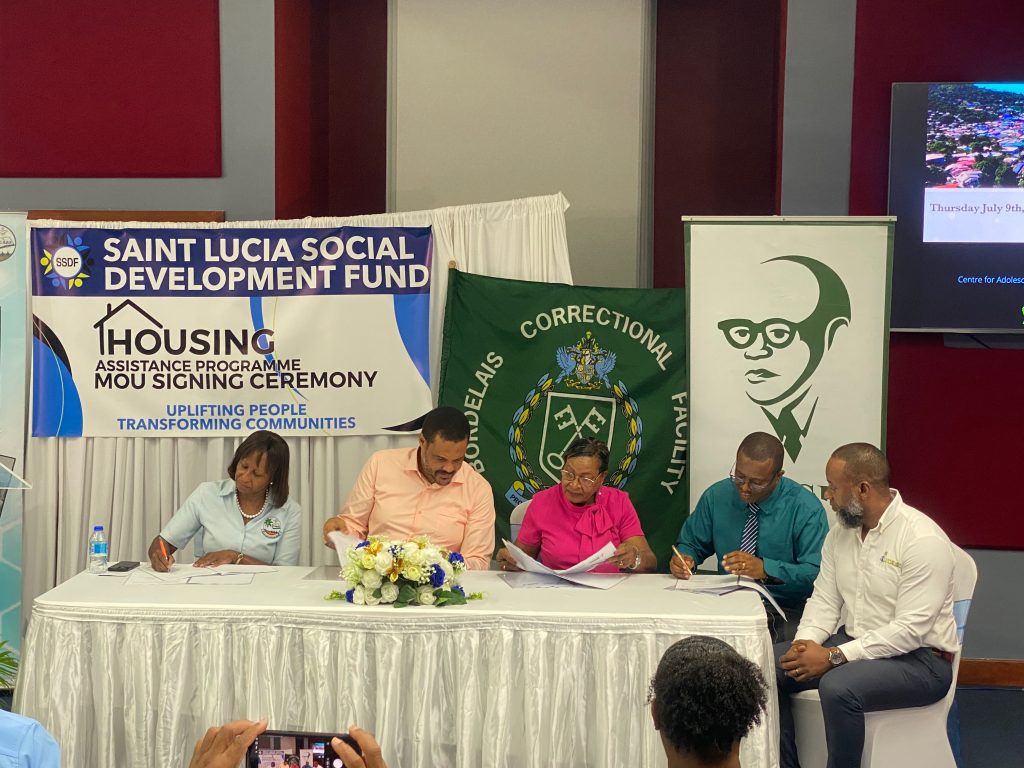
The Saint Lucia Social Development Fund (SSDF) has strengthened its efforts to provide housing support to vulnerable families through a new partnership aimed at reducing construction costs and creating training opportunities for young people.
On Thursday, July 9, the SSDF signed a memorandum of understanding (MOU) with the Centre for Adolescent Renewal and Education (CARE), the Bordelais Correctional Facility (BCF), the Sir Arthur Lewis Community College (SALCC) and Saint Lucia Electricity Services Limited (LUCELEC) for the continuation and expansion of its Housing Assistance Programme.
SSDF Executive Director John Victorin said the partnership was driven by the organization’s recognition of the impact poor housing conditions have on vulnerable households.
“In the case of the Housing Assistance Programme, the response to this question is even more pressing because we have an appreciation for the effect of poor housing conditions on the most vulnerable in our society,” Victorin said.
He explained that inadequate housing affects not only physical surroundings but also the overall wellbeing and future prospects of families.
“The reality is that poor housing conditions affect the physical and mental health of individuals. Poor housing conditions also affect most profusely the younger individuals within the household, the children within that household. It affects the future outcome of these individuals, these young children,” he said.
Victorin added that the partnership was developed to address one of the major expenses associated with housing construction.
“We felt the compulsion to explore the possibility of reducing the cost of our housing programme, especially targeting the Labour components of the programme, which is why we are here today, to sign this memorandum of understanding that would help us reduce the Labour costs of constructing houses for the prospective beneficiaries of the programme,” he said.
SSDF Housing Programme Coordinator Donna St Marthe said the agreement represents a commitment to providing more than just physical structures, but opportunities for families to improve their quality of life.
“When people have a stable place to live, they can focus on work, education, health, and build a better future,” St Marthe said.
However, she noted that many vulnerable families continue to struggle without access to adequate housing.
“Many marginalized individuals and families lack this basic human right. That is why partnerships like the one we formalize today are so essential,” she said.
St Marthe said the MOU brings together resources and expertise from several institutions to create sustainable solutions.
“Through this MOU, we aim to coordinate efforts to provide sustainable homes for the underprivileged, to empower the individuals we serve, to promote community and private sector involvement, to promote pathways for our partners to give back to society, and provide hands-on training to all involved,” she explained.
The agreement will also provide practical learning opportunities for young people enrolled at CARE, with Executive Director Dr Karleen Mason describing the partnership as a historic development for the institution.
“CARE is now making history. We’re making history because it is the first time that we would be engaged in such a partnership,” Mason said.
She explained that while CARE has previously worked with partners to provide training and employment exposure, the Housing Assistance Programme will allow young people to gain experience in a more meaningful setting.
“In the past, we have been involved in training, on-the-job training with other partners, and that has given the young people, our adolescents, an opportunity to develop their technical skills and to also practice their life skills,” Mason said.
“However, these young people are also working towards certification, and they have to develop portfolios. So now the Housing Assistance Programme provides another opportunity for them to develop their portfolio in a more authentic and meaningful way.”
Mason said the initiative also creates an opportunity to formally develop CARE’s service-learning programme, allowing young people to contribute to community development while building their skills.
Minister in the Office of the Prime Minister Dr Shanda Lee Harracksingh highlighted the importance of housing as a foundation for dignity, security and family life.
“Imagine for a moment that tonight you have no home to go back to. Or your circumstances have caused your home to be in a state of disrepair. This can be one of the most terrifying and distressing situations anyone can encounter,” she said.
The minister stressed that a home represents far more than a physical structure.
“A home is not just a building. It is freedom. It is dignity. It is hope. It is where we feel safe after a difficult day. It is where we are accepted for who we are. A place where family comes together and grows memories,” Harracksingh said.
She painted a picture of the challenges faced by vulnerable households living in unsafe conditions, including families dealing with leaking roofs, damaged floors and homes that become unsafe during severe weather.
“Imagine hearing every drip during a rainstorm. Knowing exactly which floor was cracked. Which windows won’t close. Which bucket catches the water when the roof leaks,” she said.
The minister added that the programme aims to help transform houses into safe and dignified homes for families across Saint Lucia.
Through the collaboration between government agencies, educational institutions and private sector partners, the SSDF hopes to expand access to housing assistance while creating opportunities for skills development, community involvement and social responsibility