

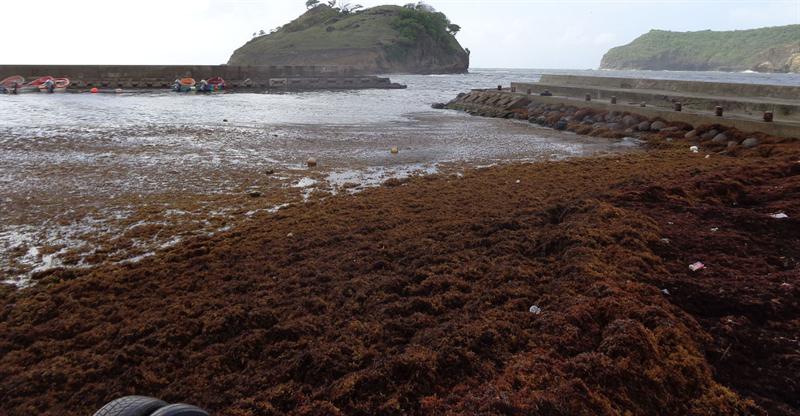
Thick accumulations of sargassum continue to affect Saint Lucia’s east coast, with fishers warning that the recurring influx of seaweed has moved beyond an environmental concern and is now threatening livelihoods, tourism and coastal communities.
Kaygianna Toussaint-Charlery of the Saint Lucia Fisherfolk Cooperative Society, in an interview this week, said the scale of the problem is becoming increasingly visible along the island’s eastern shoreline.
“This is especially so along the east coast of the island, where if you drive along the coast you can see piles and piles of sargassum along the shoreline,” she said.
According to Toussaint-Charlery, the seaweed has created serious challenges for fishers attempting to access the sea, with some experiencing damage to their equipment.
“What this has done, it has affected the ability of fishers to venture out to sea because they cannot take the vessels out through the sargassum because of how thick it is.”
“Those who have attempted it have experienced great loss with damages to their propellers of the engines.”
She said the impact on the fishing industry cannot be viewed in isolation, arguing that sargassum requires a coordinated national response involving multiple sectors.
“We cannot, as a country, assume that this is only a fisheries problem,” Toussaint-Charlery said.
She explained that while fishers are among those most directly affected, the consequences extend to the wider economy and communities located along the coast.
“Whereas the fishers are affected in terms of their livelihood, because they’re not able to venture out to sea, this is not just a fisheries issue.”
“We think it’s time that we come together and look at this very holistically.”
Toussaint-Charlery said the growing presence of sargassum is creating challenges for tourism, fishing and residents who depend on coastal resources.
“This situation affects the tourism sector, it affects the fishing sector, it affects the life of the ordinary person in the community.”
The Fisherfolk Cooperative Society is calling for a broader discussion on solutions to manage the recurring seaweed influx and reduce its impact on Saint Lucia’s coastal economy.