

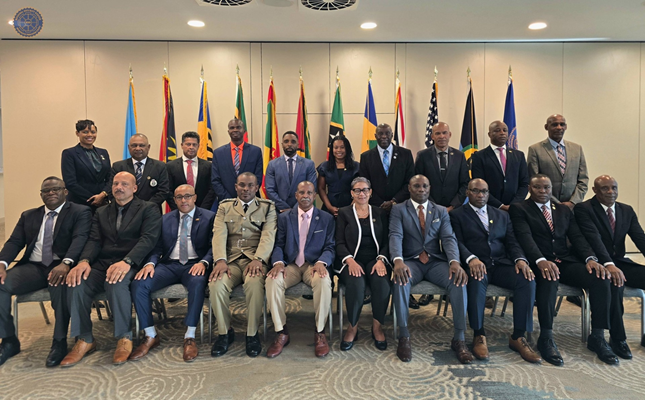
The Regional Security System Council of Ministers meeting concluded on Friday at the Harbour Club, bringing to a close several days of discussions on pressing regional and global security challenges.
The closing session featured addresses from Prime Minister Philip J Pierre and key international partners, as leaders reflected on the future of security cooperation in Saint Lucia and across the Caribbean.
Prime Minister Pierre emphasized the need for the RSS to adapt to a rapidly changing global environment.
“To continue to provide meaningful support to member countries, the RSS must find its own space within the international security ecosystem so that it can best serve the citizens it has committed to serve,” he stated.
He noted that traditional approaches to security are no longer sufficient.
“The Caribbean is no longer dealing with security in the traditional way,” Pierre said. “The RSS is expected to navigate a multidimensional landscape where digital, cultural and geopolitical forces are important security determinants.”
British High Commissioner to the OECS and Barbados, Simon Mustard, praised the work of regional institutions while urging a strategic approach to future investments.
“I look around this region in my seven months having been based out of Bridgetown and covering the Eastern Caribbean, and I am deeply impressed with the work that the RSS does, that CARICOM IMPACS does, and many of our regional bilateral partners do in law enforcement, security provision and intelligence sharing,” he said.
Mustard cautioned against unnecessary expansion, advocating instead for strengthening existing systems.
“I urge you all to think long and hard about not necessarily building shiny new things or acquiring shiny new kits but think hard about what works well and how do you amplify that, how do you accelerate that and how do you build on that,” he added.
European Union Ambassador to the OECS and Barbados, Fiona Ramsey, highlighted opportunities for deeper international collaboration.
“Within the EU, we have started reflecting on security and defense partnerships as our new framework for security cooperation with countries outside of the Union, with an aim of strengthening our bilateral relationships in this area,” she explained.
She added that global shifts are prompting countries to diversify their alliances.
“Countries around the globe are looking to diversify their partnerships to manage the heightened security risk. The European Union can be one of those partners,” Ramsey said.
High Commissioner for Canada to the OECS and Barbados, Brenda Wills, framed the discussions within a broader context of global uncertainty.
“We gather at a time when global dynamics are undergoing profound change,” she noted. “The world is witnessing a rupture in the rules-based order and a period of intensified great power rivalry.”
Wills called on smaller states to work collectively to safeguard their interests.
“Countries like ours, not the largest on the world stage but certainly not without influence, must work together with clarity and conviction to defend sovereignty, uphold human rights and strengthen multilateral institutions that underpin our collective security,” she said, echoing the RSS principle of strength through unity.
The meeting concluded with a renewed commitment among member states and international partners to deepen cooperation, strengthen institutional capacity and respond more effectively to emerging threats in an increasingly complex security environment.