

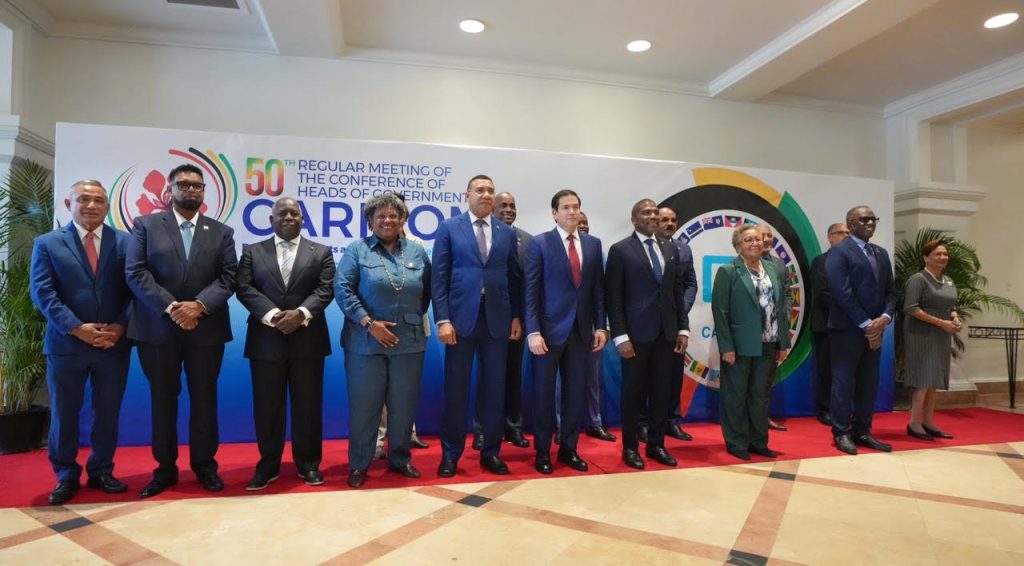
Prime Minister Philip J. Pierre has dismissed suggestions that divisions among Caribbean leaders signal weakness within the Caribbean Community (CARICOM), stressing that the region’s key institutions continue to function effectively.
Pierre made the remarks while addressing concerns that recent public statements by some Caribbean leaders on foreign policy matters reflect growing fragmentation within the regional bloc.
According to the Prime Minister, the core institutions of CARICOM remain intact and continue to serve the region.
“The CARICOM institutions, they still hold,” Pierre said. “The CXC still holds. The CDEMA still holds. The Secretariat still holds. The RSS still holds.”
He explained that the public perception of division largely stems from the fact that some regional leaders have been expressing their foreign policy positions more openly than in the past.
“What’s happening now is certain Prime Ministers are expressing their foreign policy in the open. That’s all,” Pierre stated.
The Prime Minister emphasized that CARICOM was never designed to operate as a unified political entity and therefore differences among member states should not be viewed as unusual.
“I want to make it clear, CARICOM is not a political union,” he said. “It’s very important. CARICOM is not a political union.”
Pierre noted that national political realities often shape the positions taken by individual leaders within the regional grouping.
“I told you before, this morning again, all politics is local,” he explained. “So, the CARICOM leaders are looking at their individual local political situation and expressing it to the public.”
He added that leaders within the bloc are entitled to hold and express their own views on international issues.
“Whether I agree or not agree is my prerogative,” Pierre said. “But what’s happening is not new. It’s just being expressed more in public.”
Pierre also pointed out that variations in diplomatic relationships among CARICOM states have always existed.
“There are some countries who are better than other nations with other countries,” he said.
He suggested that the increased public attention given to these differences may be creating a perception that the region is more divided than it actually is.
“Right now, because of the issue that is ventilated in the public, it appears now to be more, but it was not,” Pierre said.
The Prime Minister reiterated that diversity of views has always been part of CARICOM’s structure.
“CARICOM has never been a homogeneous body,” he added.
His remarks come amid wider regional discussions about foreign policy coordination and the role of Caribbean states in responding to global political and economic developments.