

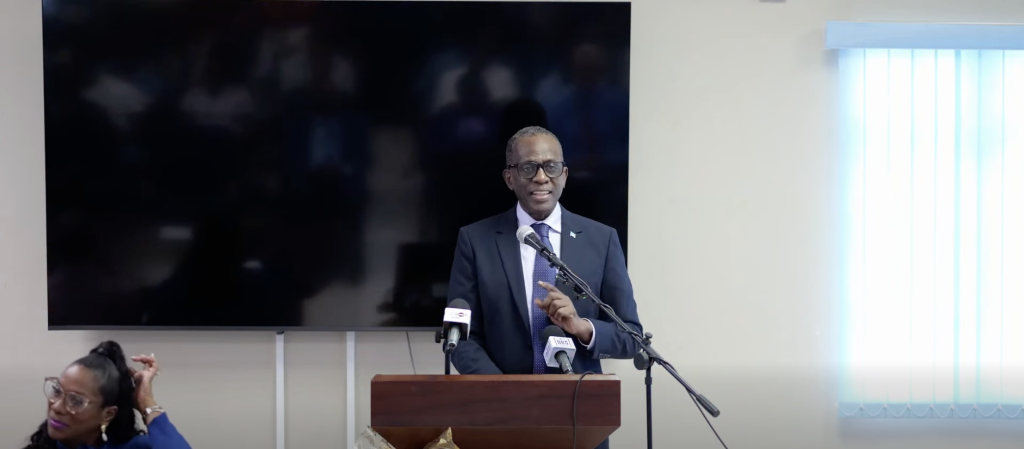
Prime Minister Philip J Pierre has pledged his government’s continued commitment to combating crime following a meeting with the High Command of the Royal Saint Lucia Police Force in the wake of two fatal shootings over the weekend.
The Prime Minister addressed the media on May 11 after meeting with senior police officials, as investigations continue into the deadly shooting incident in Marchand which claimed the lives of two individuals.
Initial reports from the police press room indicated that a male and a female sustained gunshot wounds during the incident.
One of the victims, identified as 64-year-old Pearl Ramsay of Marchand, was pronounced dead at the scene. The second victim, identified as 34-year-old Sheston Duncan of Black Mallet, Marchand, was transported to the Owen King European Hospital by ambulance but later succumbed to his injuries.
Speaking after his meeting with police officials, Pierre said law enforcement authorities have assured him that every legal effort is being made to bring those responsible to justice.
“This morning I met with the high command of the police forces, and they gave me the assurance that they will take no necessary steps to bring the people who committed these crimes to justice,” the Prime Minister stated.
“It’s a very worrying situation and everyone is concerned but the police have assured me that they are doing all in their power to take all legal means to make a situation fully under control and to arrest the people who committed these crimes.”
Pierre also highlighted a number of measures his administration has implemented to strengthen the justice system and address longstanding challenges within the courts and law enforcement sectors.
“The backlog, the case, the court did the backlog of cases. That is very significant because you have thousands of cases, hundreds of cases that have been there for years,” he explained.
“We have a dedicated court for that.”
The Prime Minister disclosed that the government intends to invest further in the training of police prosecutors through scholarships.
“We’ve announced in the budget, I’m going to give scholarships, two scholarships a year for policemen to go to study law and they’re going to be dedicated prosecutors,” Pierre revealed.
He further pointed to improvements made to Saint Lucia’s forensic capabilities and witness protection framework.
“We’ve enhanced the situation as it regards the forensic lab. The forensic lab has been enhanced. The forensic lab is doing good work and because of the resources they’ve had, they are doing more and more,” he said.
“We’ve tried, we are enhancing the witness protection. A big issue is witness protection. Witnesses are afraid to give evidence because they fear that there may be repercussions if they give evidence.”
Pierre also noted amendments to legislation aimed at improving how evidence is presented and received in court proceedings.
“We’ve changed the evidence act in terms of how can evidence be delivered and how can evidence be received,” he stated.
“So there’s a whole series of steps that the government has taken to enhance the justice system.”
Despite the initiatives, the Prime Minister acknowledged that reforming the justice system remains a gradual and resource-intensive process.
“But it’s not, first of all, it takes resources and secondly, it takes time because in our system, you’re considered innocent until proven guilty,” he said.
“This is a very important point. You are innocent until proven guilty.”
Pierre admitted that delays within the judicial process can be frustrating but maintained that legal procedures must be followed carefully.
“Sometimes it gets me impatient, but the fact is we have to go through the process,” he remarked.
The Prime Minister also addressed difficulties in recruiting judges, describing it as “a very complex situation.”
“To find judges, it’s a big issue to find people who want to sit on the bench,” he said.
“Either they’re not lucrative enough, or they can’t take the hassle, the security issues of being a judge.”
Pierre concluded by stressing the importance of early social intervention and emotional development among young people as part of the broader fight against crime and violence.
“That is why the answer to that is we must try our best to see if we can get our children from an early age to be able to control their emotions, to improve the way we deal with each other, so the environment will call for less intervention from the security forces,” he said.