

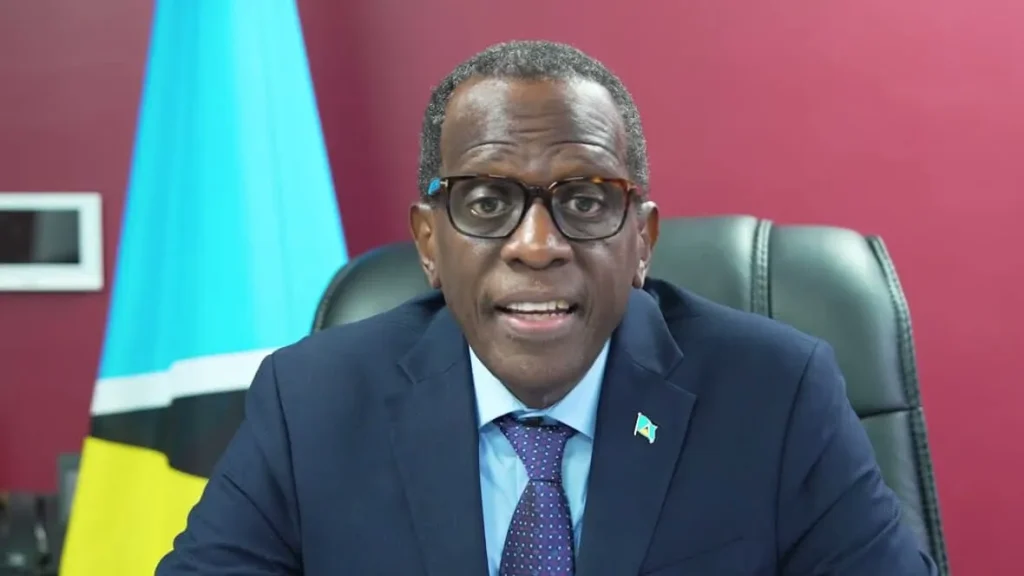
Prime Minister Philip J Pierre has defended the government’s decision to guarantee a loan of EC$121 million for the Saint Lucia Air and Seaport Authority, arguing that the investment is necessary to repair critical port infrastructure and modernise the country’s maritime sector.
Speaking during the sitting of Parliament on Tuesday, March 10, Pierre said the government’s support for the port authority extends beyond the loan guarantee and includes a range of financial concessions that have facilitated development projects.
“So apart from the guarantee, the government also supported the construction,” the Prime Minister said. “There were waivers of duties, waivers of taxes for the construction. There were waivers of corporate profit, and we helped them in their withholding fees. We waived that.”
According to Pierre, these measures demonstrate that the government has consistently provided support to the Saint Lucia Air and Seaport Authority, particularly for projects considered vital to the country’s economic development.
“So SLASPA is supported by the government, not only in the guarantee, but also supported in other ways,” he told Parliament.
The Prime Minister also signalled that broader changes may be on the horizon for the authority’s governance structure and operational model.
He revealed that a consultant has been appointed to examine the future direction of SLASPA and to consider possible reforms.
“We think it is time that SLASPA looks to new horizons,” Pierre said. “That is why we have appointed a consultant to look at SLASPA.”
Currently, the port authority operates under a governance structure that involves oversight from both the Ministry of Infrastructure and the Ministry of Finance.
“SLASPA has a hybrid management of the Minister of Infrastructure and the Finance Minister,” Pierre explained.
He suggested that reforms may be necessary to modernise the institution and better position it for future growth.
“We think that the time is coming when we must look at a complete reconstruction of the governance of SLASPA so it can be attuned to modern times,” he said.
Among the ideas being explored is the possibility of transforming the authority into a public company that would allow broader participation in its ownership.
“There is nothing wrong in saying that SLASPA can’t be a public company, with people being able to buy shares in it,” Pierre stated. “Modernising our situation so locals can buy shares in SLASPA. The private sector can buy shares in SLASPA.”