

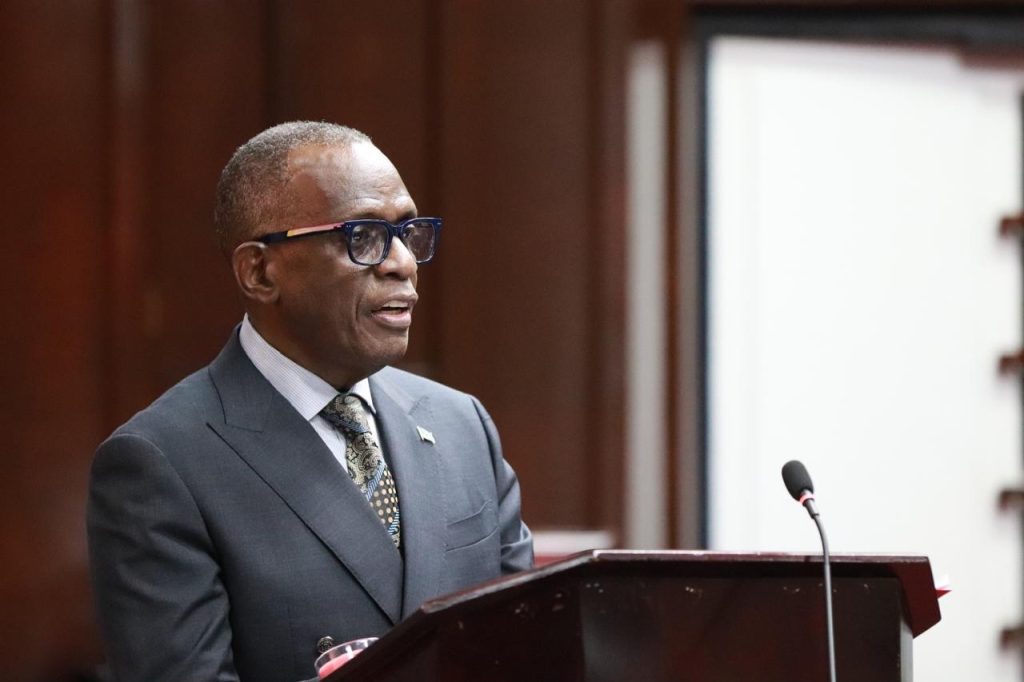
Prime Minister Philip J Pierre has voiced concern over the continuing difficulties Caribbean nations face in securing concessionary financing and achieving sustainable economic advancement, despite ongoing international discussions surrounding climate justice, vulnerability financing, and reparatory justice.
Speaking during Monday’s pre-Cabinet media briefing, Pierre reflected on the broader structural challenges confronting small island developing states, while responding to questions surrounding the 2022 Bridgetown Initiative and the 2014 CARICOM 10 Point Plan for Reparatory Justice.
The Bridgetown Initiative, spearheaded by Barbados Prime Minister Mia Mottley, seeks to reform the global financial system by making it easier for developing countries to access financing for climate resilience and disaster recovery. The proposal advocates for changes to international lending rules that critics say leave vulnerable nations burdened by unsustainable debt following climate-related disasters.
Pierre described the initiative as significant but acknowledged that progress remains slow.
“The Bridgetown Initiative, still a work in progress, work in progress, still a work in progress,” Pierre stated. “Prime Minister Mia Mottley is working seriously on it, but it’s a work in progress.”
The Prime Minister suggested that larger global powers have continued to create obstacles that hinder meaningful reform of the international financial system.
“Because the major powers always seem to find some reason why there are impediments in these things,” he remarked.
Pierre also reflected more broadly on what he described as the Caribbean’s historic struggle to attain economic independence and equitable treatment within the global economy.
“We have all these great plans. We try our best when they finalize the big policy. No, and they change the goalposts,” Pierre said.
“Anytime we’ve tried to have some level of economic independence something is put in. Anytime we try, just think about it,” he added.
While stopping short of elaborating fully on his personal views regarding the underlying causes, Pierre indicated that he believes there are deeper geopolitical considerations at play.
“It’s very complex as to why. I have my own reasons, I have my own belief,” he said.
“I said to you, I can’t say everything that I feel. I’ll be irresponsible if I say everything I feel. I’ll be very measured because of my job, but I believe I know why,” Pierre continued.
The Prime Minister pointed to recent efforts by Caribbean governments and international organizations to shift the criteria used by global financial institutions when assessing developing countries.
“What is happening now? We’re trying to get vulnerability clauses in this law. That is a major step,” he explained.
“And the United Nations and some of the international institutions are trying to measure us, not only on GDP, but on vulnerability,” Pierre added.
The issue of vulnerability financing has become increasingly important for Caribbean states, many of which are classified as middle-income countries despite facing severe climate risks, high debt burdens, and limited fiscal space.
The discussion also touched on the CARICOM 10 Point Plan for Reparatory Justice, adopted in 2014 by the Caribbean Community. The plan calls for former European colonial powers to address the enduring social and economic consequences of African enslavement and native genocide in the Caribbean.
The reparations framework includes demands for a formal apology, debt cancellation, technology transfer, public health initiatives, educational programmes, and assistance in addressing the region’s economic underdevelopment.
Regional leaders have increasingly linked reparatory justice discussions with broader calls for climate justice and equitable access to development financing, arguing that Caribbean nations continue to suffer from historical inequalities compounded by modern economic vulnerabilities.