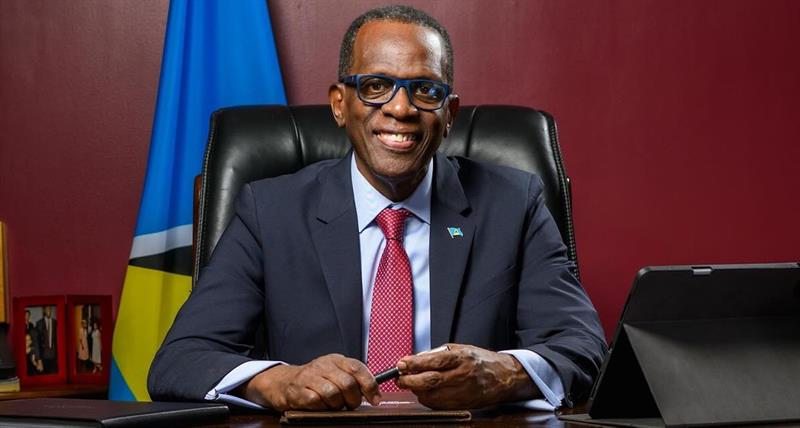
Prime Minister Philip J Pierre has provided an update on several major public works projects and outlined key policy priorities for the new term during his first pre-cabinet press briefing for the year.
Addressing progress at the Hewanorra International Airport, the Prime Minister confirmed that the long-awaited terminal redevelopment has moved through the international procurement stage.
“The Hewanorra International Airport, the terminal building, the tenders. It went through an international tender. The largest infrastructure project in the country went through an international tender,” Pierre said. He added that the process is nearing a critical milestone.
“The tenders, I understand, from SLASPA have been opened, and we should be getting from SLASPA before the end of March a result of the tender and who will be awarded a tender for the construction of the Hewanorra International Airport terminal.”
According to the Prime Minister, construction is expected to begin by mid-2026.
Pierre also announced the imminent opening of the new Gros Islet Police Headquarters, which he said will form part of the country’s independence celebrations.
“The Gros Islet Police Headquarters will be open. That will be part of our independence celebrations. So we shall open it before independence, part of our independence celebration,” he stated.
On housing and land distribution, the Prime Minister pointed to continued progress in several communities.
“The housing project at Talvern, Babonnea,u is progressing, and the housing project at Rock Hall is also going to be progressing this year,” he said. He further noted that long-standing occupants of Crown lands will finally receive formal ownership.
“This year, we also are going to be formally handing over the lands to many people who were there for more than 30 years,” Pierre explained, recalling a policy to make Crown lands available free of charge to long-term occupants. “That policy is going to be formally happen this year.”
Education remains a major focus for the government, particularly in the areas of continuing adult and special education. Pierre highlighted the importance of appointing a minister with responsibility for these sectors.
“We have a minister in charge of continuing adult and special education. That is very important to us, extremely important to us,” he said.
The Prime Minister acknowledged challenges within the education system, noting that “many children go through the system and by the end of the five years at secondary school, they basically are functionally illiterate because of different issues.”
He stressed that addressing these challenges requires specialised approaches.
“You need a special task. It’s a special task. You need a special kind of curriculum to deal with special needs children,” he said, adding that there will be “great emphasis on that” this year.
He also reaffirmed the government’s commitment to early learning, stating, “As a continuation of our Early Childhood Education Trust, we promise that Early Childhood Education is going to be free in this term. That trust is going to continue.”
Environmental management is also set to receive renewed attention. Pierre said the government will take firm action against abandoned vehicles and derelict properties.
“This year, we’re going to take very seriously the degradation of the environment; old cars and abandoned houses,” he said, describing them as “not only an unsightly sight, but it’s also a security risk.”
On fiscal policy, the Prime Minister reiterated recent measures aimed at easing the financial burden on retirees.
“Pensioners pay no tax, whether it’s a government pension or pension from the private sector, they pay no tax,” he said. He also announced increased allowances and further relief. “At the next sitting of parliament, we are going to make that law, and it’s retroactive from 2025. So there’s further tax relief,” Pierre concluded.
The Prime Minister said these initiatives reflect the government’s continued focus on infrastructure development, social support, and long-term national development.