

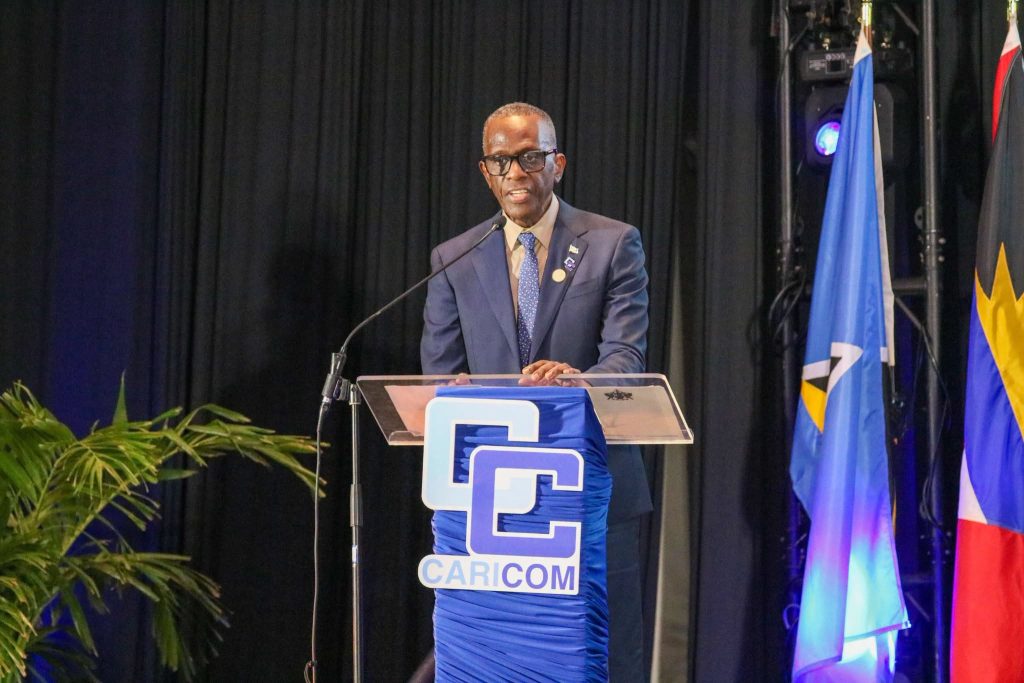
Prime Minister Philip J. Pierre has defended Saint Lucia’s Citizenship by Investment Programme (CIP), saying regional governments have taken steps to strengthen oversight and comply with international standards amid renewed pressure from European authorities to dismantle such programmes.
The issue was raised during the closing press conference of the 51st CARICOM Heads of Government Meeting in Saint Lucia this week, where regional leaders faced questions about reports that the European Union had issued formal demands to several Eastern Caribbean countries regarding their citizenship by investment schemes.
The countries reportedly affected are Antigua and Barbuda, Dominica, Grenada, Saint Kitts and Nevis, and Saint Lucia.
Prime Minister Pierre said the matter remains one primarily affecting the countries that operate CIP programmes, rather than a wider CARICOM issue.
“The CIP program only exists in a few islands of CARICOM: Grenada, Saint Lucia, Dominica, Antigua, and St. Kitts,” Pierre said. “So we see it more as an issue that we discuss among ourselves, and at the larger CARICOM level, it was not discussed.”
The Prime Minister said countries operating such programmes have made efforts to ensure they meet international expectations, including strengthening due diligence processes and regulatory oversight.
“We’ve been trying our best to follow best practice. We’ve been trying our best to ensure that all the requirements that we ask for, we’ve met them,” he said.
Pierre pointed to the creation of a unified regulatory framework through the Eastern Caribbean Central Bank as one of the measures implemented to improve governance of investment migration programmes.
“The latest requirement that we have a unified regulatory body, we’ve done that through the Eastern Caribbean Central Bank,” he said. “All the due diligence procedures that we are asked to do, we take these steps.”
However, the Prime Minister maintained that individual states retain the authority to determine their own domestic policies.
“But each country has a right to impose its own domestic policy,” Pierre said. “And we are in no position to tell anybody what to do as far as their domestic policy is concerned.”
Addressing the possibility of further action by European countries, Pierre acknowledged that Caribbean governments may have limited influence if external partners decide to impose restrictions on countries operating CIP programmes.
“Regardless of what we do, if Europe decides that they don’t want us to have a CIP program, that’s what is going to happen,” he said.
“If it is decided by Europe, by countries in Europe, that they do not want a CIP program, there’s literally nothing we can do under these circumstances,” he added.
Despite the uncertainty, Pierre said Saint Lucia and other Caribbean countries would continue to meet the requirements placed on them while drawing confidence from previous experiences where the region faced external economic pressures.
“But we’re going to follow all what they’ve asked us to do,” he said.
The Prime Minister referenced previous challenges involving the region’s banana and sugar industries, noting that Caribbean countries had complied with international demands but still experienced changes to preferential arrangements.
“We have been there before. We’ve done what we do, we took all the steps as far as our bananas were concerned, and we still lost treatment of our bananas,” Pierre said. “As far as our sugarcane is concerned, we’ve gone there before, we’ve been there before, and we’ve always survived, and I’m sure they’ll continue to survive.”
The debate over citizenship by investment programmes continues as Caribbean governments balance the economic benefits of investment migration with growing international scrutiny over issues including security, due diligence and border controls.