

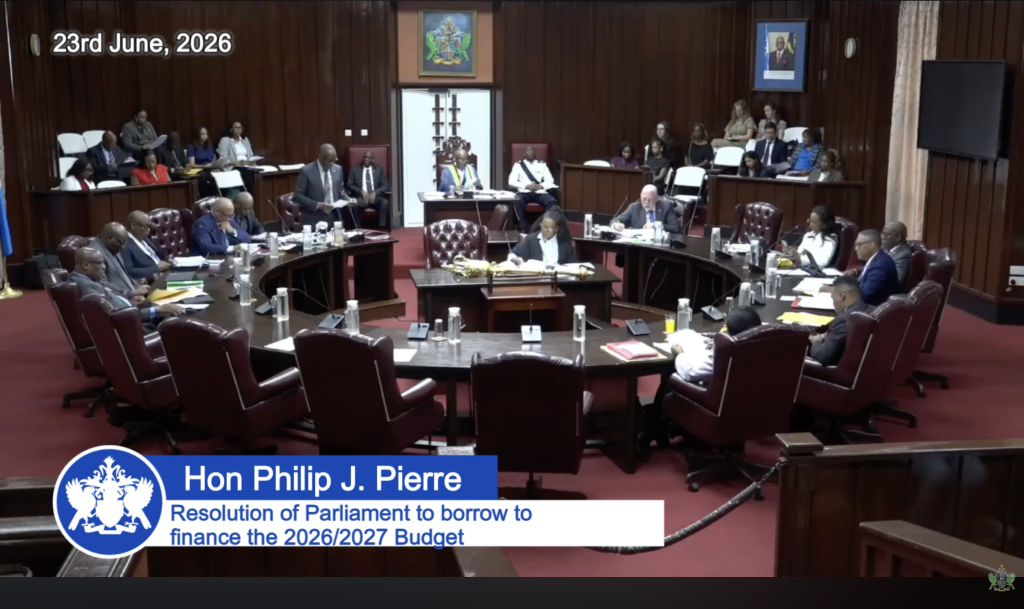
The House of Assembly on Thursday debated a resolution seeking approval for the Government of Saint Lucia to raise an additional EC$49.5 million to finance the 2026 to 2027 budget cycle, alongside the refinancing of EC$856 million in existing treasury instruments, as both sides of the aisle clashed over fiscal strategy, borrowing practices and market confidence.
Prime Minister and Minister for Finance, Philip J. Pierre, told Parliament that the motion was grounded in provisions of the Public Debt Management Act and formed part of routine financing operations to meet government obligations.
Explaining the structure of the resolution, Pierre emphasized that only a portion represented new borrowing.
“From the onset, that is the new money that we are seeking, $49.5 million,” he said, adding that, “this is what we are doing here this morning, Mr. Speaker.”
He was at pains to distinguish between fresh borrowing and refinancing operations, stating, “the other part of the resolution, $856 million, and I want to make it clear, it’s not new money. We’re not seeking to borrow $856 million of new money. These treasury bills and these bonds already exist in the system.”
He added, “we have to refinance $856 million, but it’s not new money.”
The Prime Minister also pointed to what he described as continued investor confidence in Saint Lucia’s financial instruments, arguing that existing bondholders frequently maintain their investments beyond maturity.
“Because of the confidence in the solution economy, Mr. Speaker, shows that most of these bonds are repurposed,” he said.
He added, “when these bonds or these treasury bills get a due, they are normally, they remain the system. The people who buy them, because of the confidence they have in the system, they keep that money with the government solution. They do not withdraw their money.”
According to Prime Minister Pierre, this behaviour reflects stability in the domestic financial environment. “Because of the confidence that there’s in the market and the confidence in solution, Mr. Speaker, the confidence that when these bonds mature, Mr. Speaker, they are normally kept in the system,” he stated.
Opposition Leader Allen Chastanet, however, challenged the government’s framing of the borrowing exercise and questioned the economic signals being sent by current fiscal arrangements.
He recalled a similar refinancing exercise during the COVID-19 period, stating, “in 2020, during the period of COVID, we similarly had $850 million of bonds that were due. And no, not new money, refinancing of the existing bonds.”
He noted that historically, Saint Lucia has seen high levels of bond rollover. “We have a history in this country in which the vast majority, in excess of 95% of those bonds, are turned over. And not redeemed,” he said.
Chastanet also referenced pandemic-era fiscal pressures, explaining that “25% of the bond holders and treasury bill holders during COVID redeemed their bonds or treasury bills. And the government had to find $200 million of cash.”
He further pointed to wage-related negotiations undertaken during the period, saying government officials had explored measures “to get the civil servants to forego part of their salary in exchange for bonds at 4% or 4.5% tax-free, in order to create cash flow.”
Chastanet also raised concerns about the interest rate ceiling contained in the current borrowing resolution.
“The Prime Minister has said something, and I want to challenge him on that issue. He says all is well, and that solutions should not fear, because there is a general confidence,” he stated.
However, he argued that the decision to set a maximum interest rate of 7% warranted closer scrutiny, noting, “the incentive to do so is the fact that the threshold, the maximum that we’re going to have the interest rates at, is now moved to 7%.”
He contrasted this with broader international trends, stating, “we’ve seen around the world that central banks around the world, Mr. Speaker, are actually lowering their interest rates. We also know that the ECCB has not changed their rates.”
Chastanet suggested that the rate structure may reflect market hesitation, arguing, “when we see that the interest threshold is going up, it’s because somebody must be sensing that there’s some reluctance on the buyer’s part.”
The debate underscored differing interpretations of Saint Lucia’s fiscal position, with the government emphasizing continuity, refinancing and investor confidence, while the opposition raised questions about borrowing costs and long-term financial exposure.