

Citizens are being urged to brace for a potentially severe water crisis, as meteorological and water authorities warn that the 2026 dry season is already showing signs of becoming one of the harshest in recent years. The dry season runs annually from January 1st to May 31st.
With rainfall projections falling below recent averages and river systems declining earlier than expected, officials are calling for immediate conservation and public cooperation to safeguard national water security.
Director of Meteorological Services, Vigil Saltibus, cautioned that while some rainfall may still occur early in the year, overall conditions are trending dry.
“Rainfall may occur in mid-January to March, because for the past two years, during January and February, rainfall activity has been significantly higher,” she explained. “But this January and February, we’re not anticipating as much activity as from the last two years.”
Saltibus noted that forecasts for the latter part of the dry season are particularly concerning.
“April to June forecasts favor a drier than normal conclusion to the dry season coinciding with the start of the heat season,” she said, adding that temperatures are expected to rise steadily from April into the peak heat months in September.
She further highlighted the lingering impact of last year’s rainfall deficit.
“The 2025 wet season delivered roughly 34 percent less rain than average because the wet season typically provides 70 percent of the island’s annual water,” Saltibus stated. “Reservoirs entered in 2026 in a stressed state with very low resilience for a prolonged drought.”
Echoing these concerns, Director of the Water Resources Management Agency, Jason Ernest, said current river conditions are already alarming.
“Looking at our river systems across the island, we’re seeing discharge rates that we normally see towards the end of March in a good year,” he said. “So that is very troublesome, very worrying to the agency and the Ministry at large.”
Ernest urged the public to adopt practical measures to reduce pressure on surface water sources.
“Practice rainwater harvesting as well as to expand storage,” he advised. “So the two complement each other and then that builds resilience.”
At the Water and Sewerage Company, WASCO, officials say production levels are already being affected. Chief Operations Officer Ali Anthony pointed to desalination as a critical part of long-term resilience.
“We have to feature desalination as part of our production system,” he said. “Now, the desalination, although it’s a much more expensive process, does something that it does that surface waters do not do. That is, it provides a degree of resilience that is irrespective of whatever climate you think happens.”
Anthony stressed that desalination offers reliability even in extreme conditions. “We could have a dry season that lasts years. Once you cut a desalination plant, you always have water,” he noted.
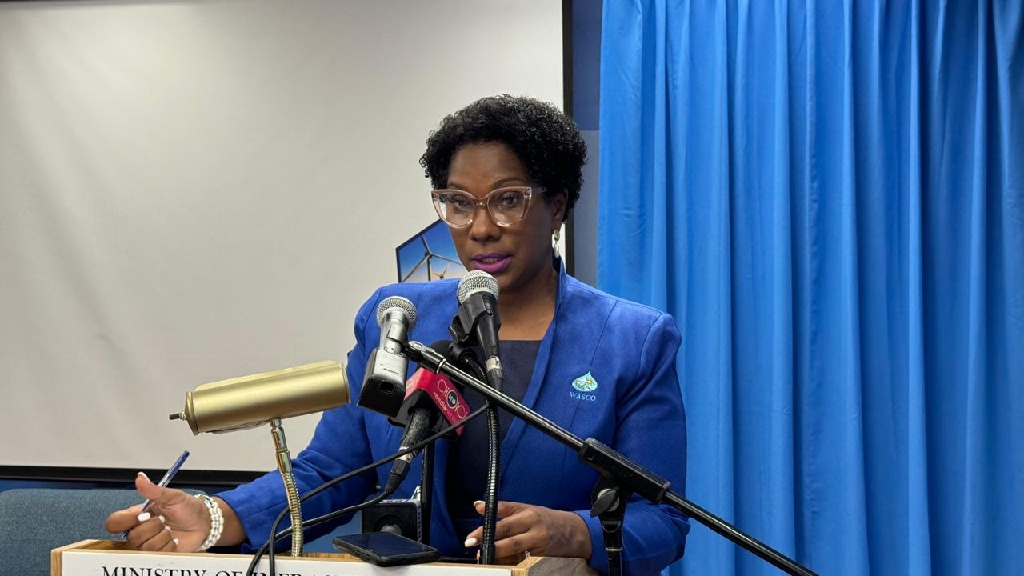
Quality Treatment Manager at WASCO, Khalidd Vidal, provided a stark assessment of declining production levels across the island.
“Since the beginning of the dry season, we’ve also seen a noticeable drop in production across all of our treatment facilities,” he said. “That’s a 10 percent drop, at least within the northern system, that accounts for about 16 million gallons of water.”
Vidal added that the situation is even more difficult when compared to previous years.
“When we compare that to 2024, going into 2025, it’s even a greater number,” he explained. “That is about 20 percent drop in our production. That could account for about 29 million gallons of water.”
The implications for households, he warned, are unavoidable.
“That really means that we’re going to experience low-pressure systems and of course, more service interruptions across that dry season,” Vidal said.
Authorities continue to stress that early action, conservation, and investment in resilient water systems will be critical as Saint Lucia confronts what could be a prolonged and challenging dry season.