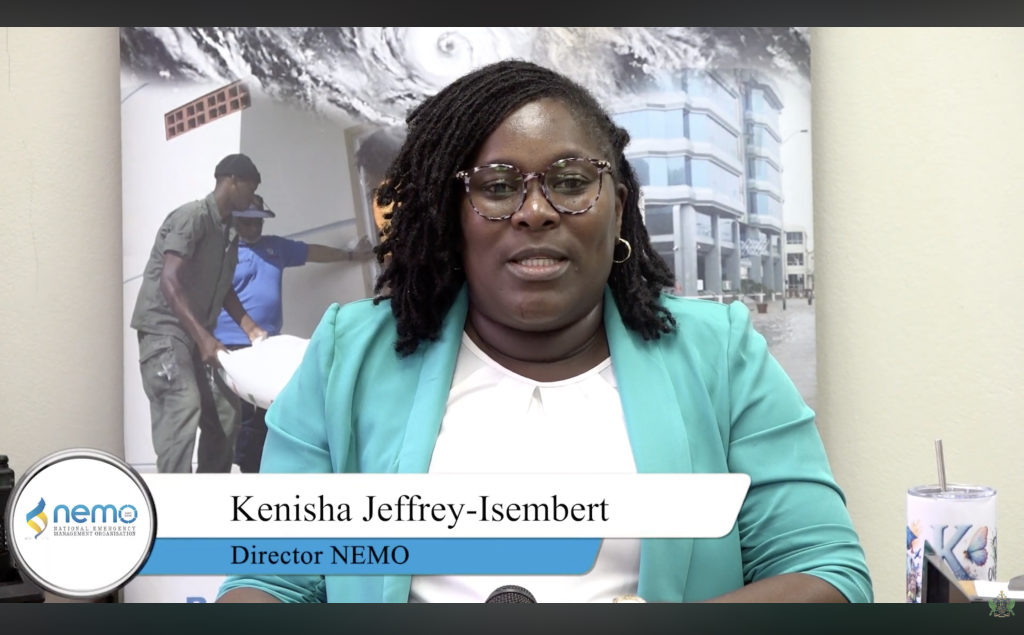
As Saint Lucia enters the 2026 Atlantic Hurricane Season, Director of the National Emergency Management Organization (NEMO), Kenisha Jeffrey-Isembert, is reminding citizens that disaster preparedness should not be confined to a six-month period, stressing that emergencies can occur at any time of the year.
Delivering her address at the commencement of the hurricane season under the theme, “Disaster does not have a season. It has a reason,” Jeffrey-Isembert called on residents to take proactive steps to protect themselves, their families and their communities.
“We encourage every household to review emergency plans, clean drains and waterways, trim overhanging branches, stock essential supplies, secure important documents, and stay informed through official sources,” she said.
However, the NEMO Director emphasized that preparedness extends beyond hurricanes and tropical storms.
“But it is even more important to remember that disaster can strike at any time, not just during the hurricane season,” Jeffrey-Isembert noted. “We have seen this before. The Christmas Eve trough of 2013 occurred nearly a month after the official close of the hurricane season and remains one of the most expensive disasters to impact Saint Lucia since Hurricane Thomas.”
According to Jeffrey-Isembert, the lessons from past disasters underscore the need for constant vigilance and sustained preparedness efforts throughout the year.
“With this recognition, it is important to note that NEMO’s work does not begin on June 1 and end on November 30,” she said. “Preparedness does not have a season. It has a purpose, protecting lives, safeguarding property, preserving livelihoods, reducing suffering, and ensuring that communities can recover quickly when disaster strikes.”
She highlighted the extensive work undertaken by NEMO to strengthen community resilience, noting that the organization works year-round with disaster management committees across the island.
“In keeping with our mandate, NEMO works year-round to prepare our 18 district disaster management committees through training programs ranging from first aid and community emergency response team training to radio communications and customer service,” Jeffrey-Isembert explained.
The agency also partners with schools, businesses, government departments and other institutions to conduct emergency exercises and preparedness activities.
“Beyond the District Disaster Management Committees, we conduct tabletop exercises, evacuation drills, and emergency preparedness activities with schools, government ministries, hotels, financial institutions, and businesses throughout the island,” she said. “These efforts are critical to ensuring that solutions are equipped to assist one another in times of emergency.”
Jeffrey-Isembert also drew attention to one of NEMO’s lesser-known responsibilities, ensuring safety and emergency preparedness at large public events, particularly during the island’s busy festival season.
“As we commence the hurricane season, NEMO also has a role in the organization of mass crowd events, such as jazz and particularly carnival, which takes place during the period,” she said.
She revealed that public surveys conducted between 2024 and 2025 showed that many people remain unaware of this aspect of NEMO’s work.
“As evidenced by our 2024-2025 public survey, one of NEMO’s least understood responsibilities is our role in ensuring that mass crowd events adhere to emergency and safety requirements,” Jeffrey-Isembert stated. “Yet, this function is critically important.”
“Large gatherings bring together thousands of people and proper evacuation planning, emergency access, traffic management, and hazard mitigation measures are essential to protecting life and property,” she added. “Careful planning helps prevent man-made incidents from becoming tragedies.”
The NEMO Director also praised public participation in the organization’s Ziploc Bag Drive initiative, which aims to help residents safeguard important documents from flood and water damage.
“We are also encouraged by the response from communities participating in our Ziploc Bag Drive initiative,” Jeffrey-Isembert said. “Through this program, residents receive waterproof bags to protect important documents from flood and water damage. The growing participation we have seen demonstrates that more citizens are recognizing the value of preparedness.”
She extended gratitude to community partners who have supported the programme.
“We extend profound thanks to Elder Bowman, Elder Josephson and The Church of Jesus Christ of Latter-day Saints without whose partnership this initiative would not have been possible,” she said.
Jeffrey-Isembert further outlined improvements to the island’s emergency communication infrastructure, describing them as critical to national disaster response efforts.
“Over the past year, under the leadership of our telecommunications officer, significant work has been undertaken to improve NEMO’s emergency radio network,” she revealed.
“Presently, communication between the north and south of the island is operational. Plans are also on the way to install repeaters in the Choiseul-Soufriere region on the west coast and in Dennery on the east coast by the end of 2026, further strengthening our national emergency communications capability.”
As the hurricane season gets underway, NEMO is encouraging all Saint Lucians to remain prepared, stay informed through official channels and take personal responsibility for reducing disaster risks before emergencies occur.