

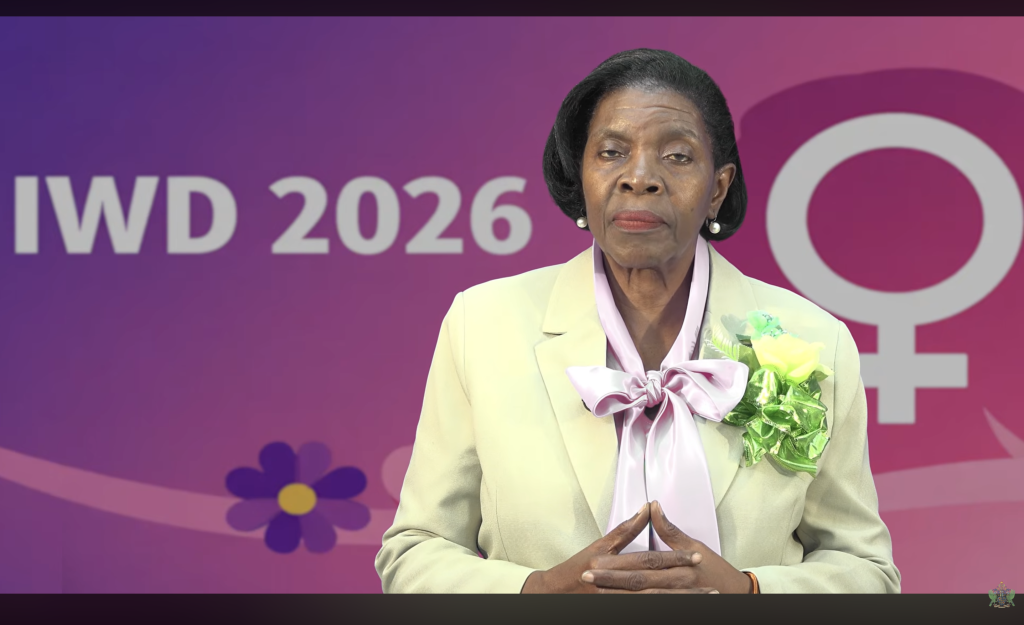
Saint Lucia has joined the global community in observing International Women’s Day with a call for stronger action to advance gender equality and protect the rights of women and girls across the island.
Minister for Gender Affairs Emma Hippolyte delivered the national address, reflecting on the significance of the observance and the progress still required to ensure that all women can fully participate in social and economic life.
International Women’s Day, celebrated annually on March 8th, has been recognized for more than a century and remains a platform for celebrating the achievements of women while raising awareness about discrimination and the ongoing pursuit of gender parity.
Hippolyte noted that this year’s observance is guided by the United Nations theme focusing on rights and equality for women and girls.
“This year’s official theme for the United Nations Entity for Gender Equality and the Empowerment of Women is Rights, Justice, Action for All Women and Girls,” Hippolyte stated.
“This theme jolts us to consider the lived reality of all women and girls and challenges us to take action to ensure that protection, respect and fulfilment of rights do not pertain only to a select few but to all.”
According to the minister, International Women’s Day should serve not only as a celebration but also as a moment of national reflection and commitment to progress.
“In practical and palpable ways, therefore, this theme calls for more than a mass celebration of women. These observances provide a space for national reflection,” she said.
Hippolyte highlighted the government’s “Putting People First” agenda and its “Douvan Ansanm” approach as guiding principles for inclusive development.
“The Government of Saint Lucia considers the rights of all in its Putting People First Agenda. The Government of Saint Lucia further magnifies the Putting People First Agenda in the last few independence celebrations under the banner of Douvan Ansanm,” she explained.
“It is a declaration of a shared belief that for all to progress, we must do it together or we will not progress at all.”
The minister pointed to several policies and initiatives aimed at removing barriers that have historically limited women’s economic participation.
“The government of Saint Lucia has demonstrated its commitment to ensuring that all citizens have opportunities to thrive by removing structural barriers that unintentionally bar women from economic development and freedom from violence,” Hippolyte said.
She noted that programmes such as the MSME loan grant facility and the Youth Economy Agency have expanded access to start-up capital.
“The MSME loan grant facility and the Youth Economy Agency make it easier to access startup capital that has traditionally been far less accessible for women,” she explained.
Legislative changes have also helped broaden access to financing.
“The security interest in movable property legislation passed in the last two years further removed a structural barrier for women to access finance,” Hippolyte stated.
“Land ownership, less likely for women, was suddenly no longer the only asset that could be leveraged for credit.”
The minister also highlighted social policies aimed at addressing everyday challenges faced by women and girls.
“More glaringly, the removal of VAT on sanitary napkins and the provision of resources to schools to provide sanitary napkins for girls validated that women and girls as a group could not run away from this expense,” she said.
“This measure relieved the financial burden on women to take care of their basic needs, at least to some extent.”
Hippolyte also referenced legislative protections against domestic violence.
“The well-known Domestic Violence Act ensured the protection of not some, but all women and men from family and domestic violence,” she added.
“These are some of the few practical and substantial ways in which the government of Saint Lucia has acted to ensure that all women and girls enjoy their rights.”
Despite these advances, the minister stressed that much work remains to be done to achieve full gender equality.
“There continues to be a clarion call for partnership, and we recognize that we have a long way to go,” Hippolyte said.
She referenced findings from the 2026 World Bank Women, Business, and the Law Report to illustrate the global challenges women continue to face.
“The 2026 World Bank Women, Business and the Law Report revealed that only about four percent of women worldwide live in areas that directly impact economic participation including childcare systems and parental support, protection from violence and workplace harassment, access to credit and financial services and workplace protection and labor rights,” she noted.
While acknowledging that these statistics may not fully reflect the local reality, Hippolyte said Saint Lucia must continue working to remove remaining barriers.
“We are mindful that these statistics do not reflect our reality in Saint Lucia. However, we have to bridge this gap.”
She concluded by urging greater attention to social expectations that often place caregiving responsibilities primarily on women.
“We must be serious about dismantling the structural barriers that remain intact such as gender stereotypes that undervalue childcare, care of the elderly and care of persons with disabilities,” Hippolyte said.
“In so doing, we thrust the responsibility for these imperatives exclusively on women.”