

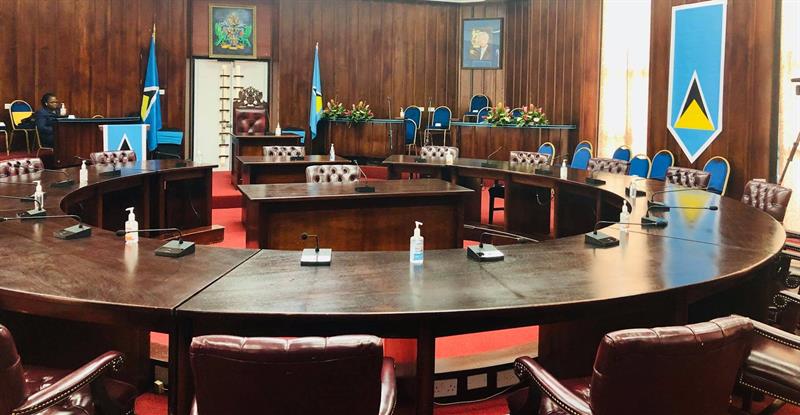
The Parliament on Tuesday held a spirited debate on the Eastern Caribbean Citizenship by Investment Regulatory Authority Agreement Bill, marking a significant step toward harmonized oversight of Citizenship-by-Investment (CBI) programmes in the region. The Bill, prepared under the Eastern Caribbean Central Bank framework, aims to enact enabling legislation that gives legal effect to the regional CBI regulator known as ECCIRA.
CBI (Citizenship by Investment) programmes have become an important source of revenue for many Caribbean nations. In the OECS sub-region, Antigua & Barbuda, Dominica, Grenada, St. Kitts & Nevis, and Saint Lucia operate CBI/CIP schemes, which allow foreign investors to obtain citizenship by making qualifying investments.
During the debate Minister responsible for the Citizenship by Investment Programme (CIP), Dr Ernest Hilaire, stressed the need for tighter regulation of investment-linked developments.
He said that when developers propose real-estate linked citizenship options, negotiations often include granting “a certain number of shares, which equivalent to applications.” He explained that those applications are tied to the developer’s overall project costs; not just construction but also marketing, commissions, and consultancy expenses.
Hilaire warned that a misalignment currently exists in the system: “You could very well have a property development that the construction cost is 200 million, but the total development cost might be 300 million.” He added that in some Caribbean countries, including in Saint Lucia, “you don’t see the alignment between the two” (development cost vs. reported investment).
He singled out high commissions as a core problem: “The real crux of the problem that we face … is the high commissions that are paid. It allows for rebates to be offered and all kinds of price adjustments to take place. We’re going to change the approach.”
Not all lawmakers supported the Bill without reservations. MP for Vieux Fort South Dr. Kenny Anthony warned that it grants sweeping powers to a regional authority at the expense of national sovereignty.
He referred to Article 10 of the Bill, which grants “powers of the authority,” including “recommend or direct a participating state.” He asked: “Do you know the full extent to which we are ceding our authority?”
Anthony said that allowing a body to issue directions to member states is unacceptable.
He remarked, “We have now become the European Union. … I will never, ever, ever allow a body like this to give my country directives or to give me directives in my own space, surrender my sovereignty.” His warning underscored fears that national decision-making could be constrained by a regional regulator.
Opposition Leader Allen Chastanet also questioned the need for the legislation itself. He claimed the government did not bring forward this Bill to improve regulation, but only after pressure.
He said that the government “was forced to bring this to the House,” and argued that these amendments are “a result of bad management.” He challenged the government’s claim of transparency and accused it of hiding evidence.