

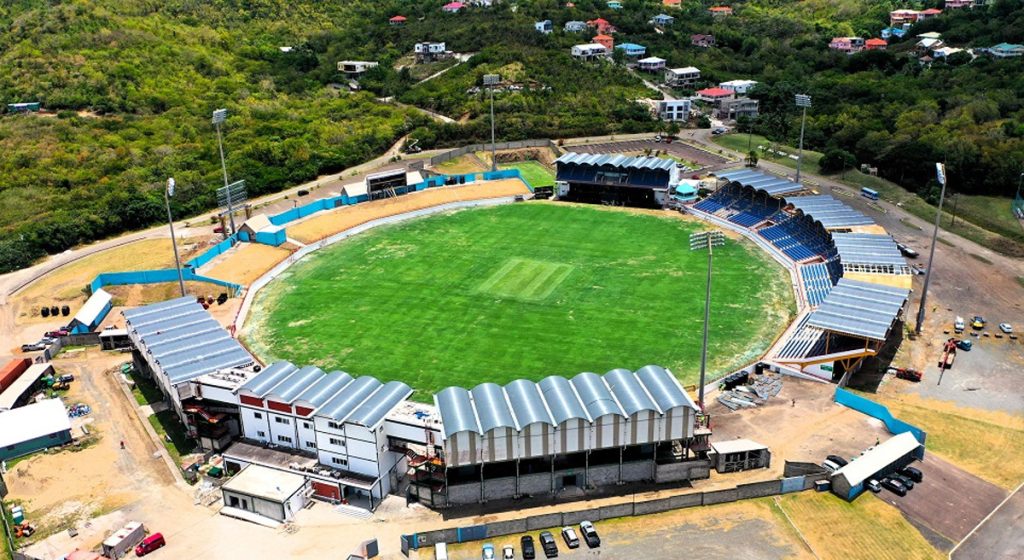
Tourism and Investment Minister Ernest Hilaire has defended the use of sporting facilities as entertainment venues, arguing that the island’s limited resources make multi-purpose infrastructure not only practical, but necessary.
Speaking at a media engagement on Monday, May 4, Hilaire said the debate should center on management rather than restriction.
“I believe as a small island state, we have limited facilities, that is the truth. And it comes down to a question of management. How do we manage the use?” he stated.
Drawing on his experience in the development of the Daren Sammy Cricket Ground, Hilaire explained that the facility was deliberately designed to accommodate both sport and entertainment.
“We actually designed the stadium for the purposes of concerts. The northern stands are shaped like an Amphitheatre… so to allow for us to have concerts there,” he said.
He noted that significant investment in a specialized sand-based outfield was intended to enhance both athletic performance and versatility.
“You spend a lot of money on the surface so you can have versatility of use… you want to have surfaces that you can use for multiple purposes. And it takes very little to restore it.”
Hilaire rejected the notion that separate facilities should be built for each activity, pointing to financial constraints.
“We just cannot afford every community to have a cricket field, a football field, and an entertainment venue of that size,” he said, referencing large crowds at recent events in Soufrière and Vieux Fort.
“Otherwise, what are you going to do? Spend $20 million on an entertainment venue in Castries, and when Dennery wants an event, you say everybody must go to Castries? It’s not making sense.”
Instead, he advocated for strategic investment in adaptable infrastructure across key communities.
“You have to build the Dennery playing field in a way where it allows you to have mass crowd events there… we need to be very respectful of athletes and sporting youths, but we also have to understand, we don’t have the resources to have dedicated facilities.”
A central pillar of the Minister’s position is the responsibility of event organizers to restore venues after use.
“In the carnival budget you must have money to restore the field to the condition you got it. That must be part of your expenses,” he stressed. “If it is a proper surface, a sand cap, it doesn’t take much to restore it… it can’t be a cop-out.”
Hilaire also highlighted past efforts to design multi-functional spaces, including indoor sporting facilities capable of hosting a range of activities. “The indoor facility at Beausejour was supposed to be a cricket indoor practice facility… but it was built in a way where we can play basketball, volleyball, netball… you could also have church and crusades there,” he explained.
Referencing international examples such as Madison Square Garden, he argued that modern venues should be built with flexibility in mind.
“You design it in a way. You make the investment to allow that to happen. I’m not into this thinking that this is a sport facility and it must not be used for anything else.”
While acknowledging concerns from athletes and sporting stakeholders, Hilaire maintained that a balanced, well-managed approach offers the most realistic path forward for small island states seeking to maximize limited infrastructure.