

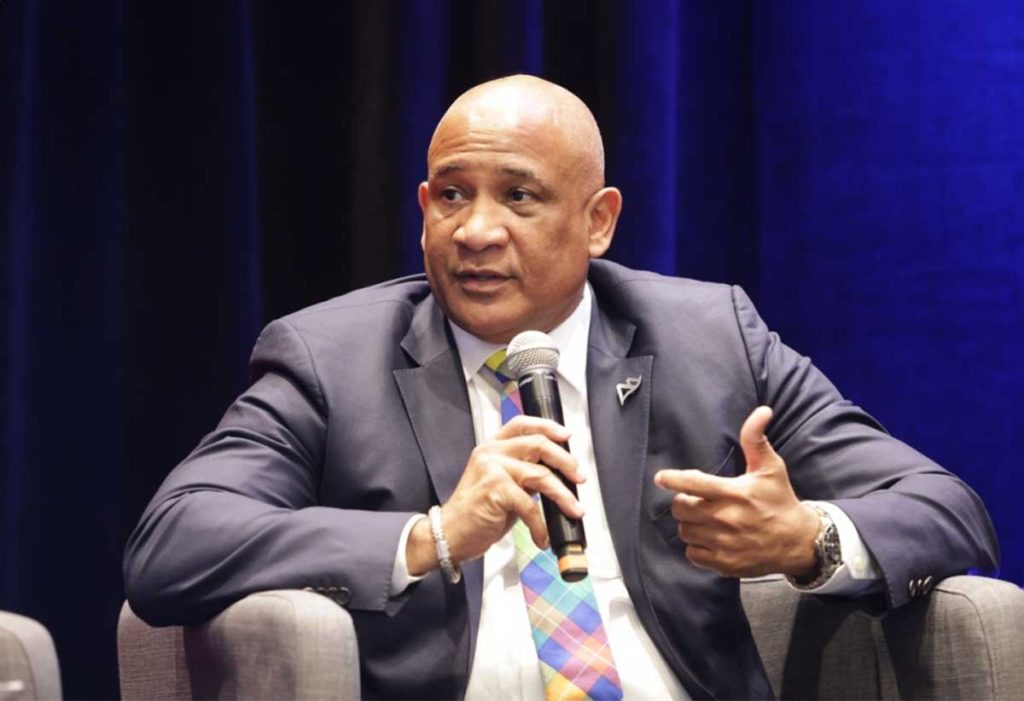
The future of Caribbean Citizenship by Investment programmes took center stage in Saint Lucia as regional and international stakeholders gathered for the Caribbean Investment Summit under the theme “Convergence: Advantage in Global Capital and Mobility.”
Speaking during the summit on Friday, May 08, Investment Minister Dr Ernest Hilaire stressed that the long-term survival of Caribbean Citizenship by Investment programmes depends on stronger regulation, enhanced transparency, and maintaining the confidence of international partners.
“How do we ensure the survival of Caribbean CBIs?” Hilaire asked. “Let us start off by accepting that it is a very young industry.”
He noted that compared to sectors such as banking, financial services, and international trade, Citizenship by Investment remains relatively new and requires significant oversight.
“And if you compare it to banking, to financial services, to trade in commodities and trade in currency, it is a young industry and it needs regulation,” Hilaire stated.
Describing the sector as “high-risk,” the minister acknowledged the international concerns surrounding national security and due diligence.
“It is a high-risk industry and more importantly it is high-risk especially to our international partners because of the national security considerations,” he explained.
“So, we should not run away from that fact. And that’s why for me the first principle is always the commitment to our international partners that we will prioritize due diligence.”
Hilaire also addressed longstanding criticisms levelled against Citizenship by Investment programmes, including allegations of corruption, weak accountability, and insufficient transparency.
“But even beyond the need for regulation, there is just so much that is said about the citizenry by investment programs, the accusations of corruption, lack of transparency, lack of accountability,” he said.
The minister argued, however, that such concerns are not unique to the investment migration industry.
“It’s not necessarily new and unique to the CBIs,” Hilaire noted. “The same can be said in the banking industry, in trading, it happens.”
Still, he conceded that reputational damage has affected the sector and warned that the presence of unethical actors cannot be ignored.
“A lot of reputations have been destroyed because of this industry,” he said. “But we cannot escape the fact that we need regulations, that there are bad actors, and there are people who do not uphold ethical principles and standards.”
Hilaire also sought to distinguish Saint Lucia’s approach to Citizenship by Investment from what he described as purely revenue-driven models.
“For us, the program in Saint Lucia has to be more than just revenue, how much money we can make out of it,” he declared.
“We’ve always said, we said so in 2016, and I’m saying it again now. For us, it is not a transactional engagement. It’s an interactional engagement.”
The minister said Saint Lucia wants successful applicants to become active contributors to national development rather than passive investors.
“We’re not doing it for the sake of just the revenue,” Hilaire said. “We want vibe in our dealings. We want you to become part of the Saint Lucia landscape.”
He encouraged prospective citizens with specialized expertise to establish themselves in Saint Lucia and contribute directly to sectors such as research and healthcare.
“If you are qualified scientists, and you believe you can set up a research institute in Saint Lucia, come and do so as a Saint Lucia,” he said.
“You don’t need any license or any special permission, you’re a Saint Lucia. If you believe you are cardiologists of international standing, come and open a clinic in Saint Lucia.”
Hilaire concluded by emphasizing the broader vision behind the programme, stating that Citizenship by Investment should ultimately contribute to national growth and strengthen the country’s human capital.
“Whatever the skills and competencies, Saint Lucia is your home,” he said. “So, we’ve now expanded beyond 180,000, and for us that’s important.”