

The Royal Saint Lucia Police Force has announced a gun amnesty scheduled for next week as part of an intensified national effort to curb violent crime, signalling a tougher stance on illegal firearms following a challenging but comparatively improved year for law enforcement.
The announcement was made during the RSLPF’s first press conference of the new year, where senior officers outlined operational results for 2025 against the backdrop of 70 homicides, a reduction of six when compared to 2024.
Police leaders emphasised that removing illegal guns from communities remains central to reducing violence and saving lives.
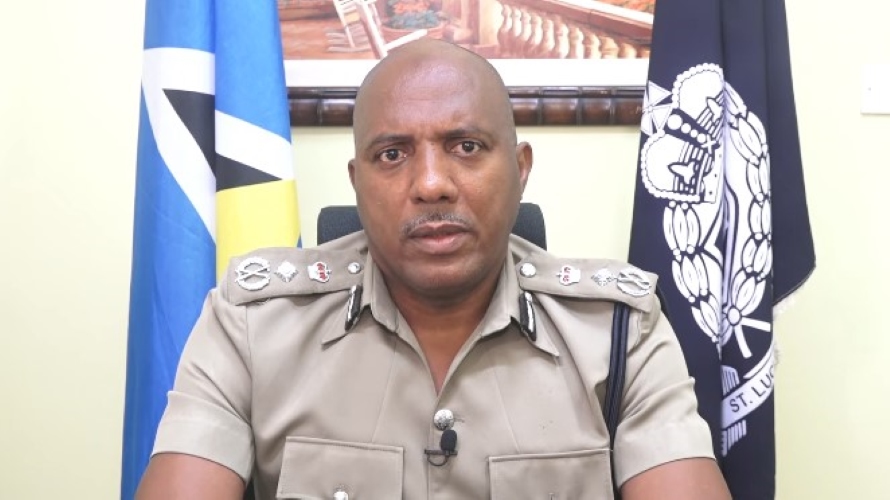
Police Commissioner Verne Garde said the amnesty is a critical opportunity for individuals to surrender illegal firearms before the Force moves aggressively against offenders.
“Next week, we will have a gun amnesty,” Garde said. “Because we need to take all firearms off the street. And when we are done with the amnesty, we will be going aggressively to deal with lawbreakers regarding the possession of firearms.”
He warned that illegal gun possession will be treated as a serious threat to national safety.
“We will look at everybody who has an illegal firearm as somebody who wants to cause destruction and loss of life, and we will treat the matter affirmatively. I think it is really time that the Royal Saint Lucia Police Force put its foot down on some of these more serious matters,” the Commissioner stated.
Garde described 2025 as “a very tough year and busy year for law enforcement,” but said crime statistics point to modest improvements.
“Based on the statistics, it reflects a marginal drop in crime in many areas,” he noted, adding that a full crime landscape will be presented on February 5 once data collation is completed.
He acknowledged the human toll of violent crime, stating, “For 2025, we saw the loss of 70 individuals through violent crime. I want to, again, express my sympathy to all the family members because the life of every individual in Saint Lucia is an important life.”
Deputy Commissioner of Police Ronald Phillip highlighted firearm-related violence as a persistent concern but pointed to notable enforcement gains.
“Most of our murders, we realise, the commission of these offences is for the use of firearms. It continued to remain of concern to the police organisation,” Phillip said.
“Notwithstanding, I could tell you that we had a nearly 40 per cent increase in the number of firearms recovered islandwide. So this in itself is a significant achievement for law enforcement.”
Phillip also cited strengthened collaboration with agencies such as the Financial Intelligence Authority, Customs and Excise, and external partners, as well as increased government investment in policing resources. He noted that more than 80 police officers are currently in training and are expected to graduate this month, boosting operational capacity.
Assistant Commissioner of Police Luke Defreitas outlined a range of targeted strategies aimed at reducing both violent and non-violent crime in 2026. He stressed that public cooperation remains essential.
“As we have always said, assistance from the public is absolutely critical in such situations,” he said.
Defreitas identified several crime and accident hotspots, particularly within the Castries basin. He noted that while fatal accidents decreased by nearly 50 per cent in 2025, road safety remains a concern due to high collision volumes.
“The John Compton Highway is noted for both pedestrian-related risk and opportunistic thefts,” he said, while “Darling Road is a major hotspot for both traffic congestion and street-level crimes such as stealing from persons and robberies.”
To address these issues, Defreitas said the Force will implement “saturated public space patrols,” including increased deployment of plainclothes and uniformed officers in areas such as Gros Islet and Forestiere. He also pointed to enhanced firearm interdiction efforts.
“We intend to maintain intensified intelligence-led operations, focus on inland recoveries and seizures of firearms and ammunition, and also increase our work at our ports, both legal ports of entry and our porous borders,” he stated.
Technology will play a greater role, with plans to expand real-time CCTV monitoring.
“We have almost 800 cameras,” Defreitas said, adding that monitoring will be decentralised to district stations. “If we can monitor our CCTV in real time, we can actually intercept the commission of a lot of what happens, especially within the city centre.”
Community-based approaches will also be strengthened. Defreitas explained that the Force intends to expand residential security partnerships and community policing initiatives in burglary hotspots, encouraging better lighting and neighbourhood watch programmes.
Domestic and interpersonal conflict resolution is another priority. “Since many of our wounding and assault cases stem from domestic disputes, we want to expand community-based conflict resolution programmes to prevent escalation to lethal violence,” he said.
Commissioner Garde said the country’s current crime challenges developed over many years but expressed confidence that sustained policing efforts would gradually reverse the trend and lead to long-term improvements in public safety.