

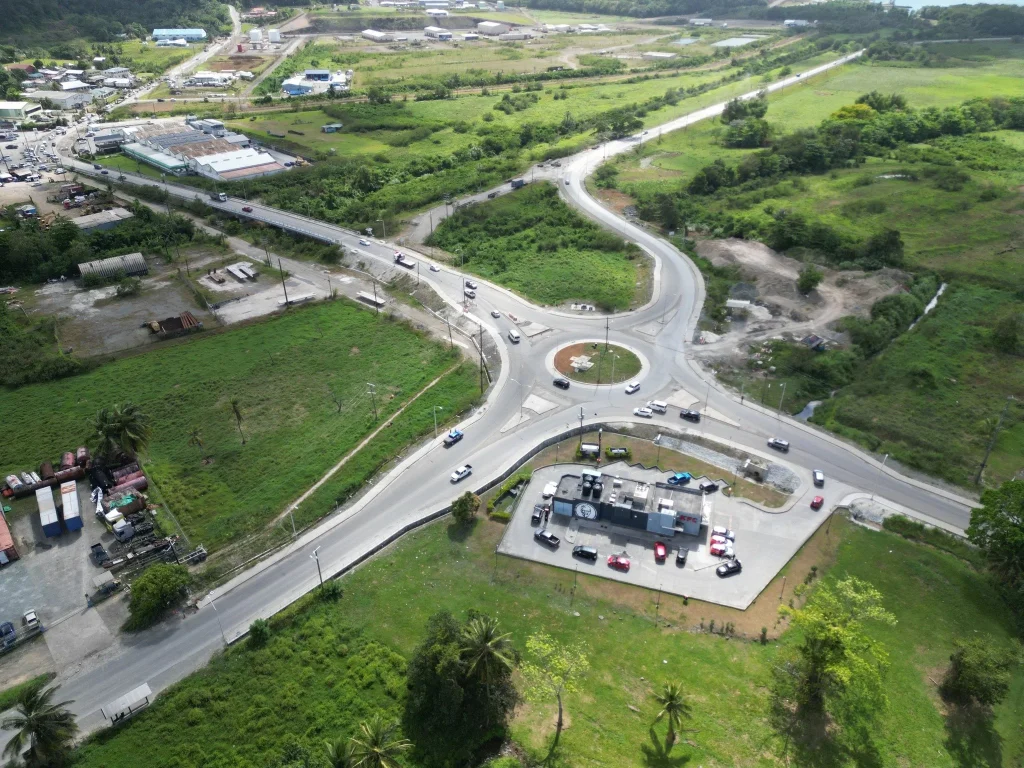
Prime Minister and Minister for Finance, Philip J Pierre, has presented a motion in Parliament seeking authorisation to borrow an additional US$10.813 million from the Caribbean Development Bank (CDB) to assist in completing the Millennium Highway Reconstruction Project and the West Coast Road Project.
The motion was laid during the March 10 sitting of the Parliament of Saint Lucia, as the government acknowledged that the long-delayed project has been affected by cost overruns and delays since construction began.
The highway rehabilitation programme has drawn considerable scrutiny from Saint Lucians. Originally scheduled to begin in July 2021 and conclude in January 2024, the works have faced setbacks linked to the global disruption caused by the COVID-19 pandemic, along with supply chain challenges affecting the procurement of materials and equipment.
The project itself stems from a grant secured from the United Kingdom government in April 2018, valued at £30 million, approximately EC$115 million. According to a statement issued at the time by the Ministry of Infrastructure, the reconstruction was to be financed through the United Kingdom Caribbean Infrastructure Partnership Fund (UKCIF).
That announcement was made by then Minister for Infrastructure, Stephenson King during the 2018–2019 Estimates of Revenue and Expenditure debate.
During the debate on the new borrowing motion, Pierre outlined the origins of the UKCIF arrangement and the earlier vision for the funds.
“The UKCIF, Mr. Speaker, was negotiated with Dr. Kenny Anthony when he was Prime Minister and Minister of Finance,” Pierre told Parliament.
He explained that the initiative formed part of a broader infrastructure funding programme offered by the British government to Caribbean states.
“At that time, the thinking of the government, and not only in Saint Lucia but throughout the region, was that the UK government would give a grant to help with infrastructure development,” Pierre said.
He noted that the initial concept involved constructing a cross-island highway linking the north of Saint Lucia to Vieux Fort.
“At that time, the government decided that that money would have been used for the construction of what is called a Chimi Royale, a highway from the north of the country to go across the island and land in Vieux Fort,” he stated.
Pierre said a feasibility study conducted by the Caribbean Development Bank informed those early discussions. He also recalled that the opposition parliamentarians had been invited to consultations on the study.
“When that study was done, the member for South East Castries, who was in opposition at the time, was invited to have a discussion on that feasibility study at the Bexon School,” Pierre said. “I spent five years in opposition, and I was never invited to have a discussion on anything.”
Following a change in government, the plan for a cross-island highway was abandoned and the funds were redirected towards upgrading the Millennium Highway and sections of the west coast road.
“The government changed and the then government decided that they were no longer pursuing that venture,” Pierre explained. “They decided that they would put that money into the Millennium Highway, starting from Faux à Chaud and building the road up to Soufrière.”
He told Parliament that subsequent revisions placed the project cost at approximately US$64.9 million, equivalent to EC$172.8 million.
Pierre also revealed that the government had to seek extensions from the UK CIF programme due to project delays.
“The Ministry of Finance had to be literally begging UKCIF to extend the grant agreement because we were running out of time,” he said. “You have to use these grants over a particular time and we were losing time.”
According to Pierre, the combination of delays and rising construction costs left the government facing a financing gap.
“As in all these things, the cost of the project increased,” he told the House. “We found ourselves in a position where we were 10 million US dollars short. So, we had to go to the CDB to borrow 10.8 million US dollars to supplement the UKCIF grant to complete the road.”
Under the motion presented to Parliament, the government is seeking approval to amend the existing loan agreement with the Caribbean Development Bank to secure the additional funding.
The proposal states that the additional loan will carry a variable interest rate of 5.6 per cent per annum, replacing the earlier fixed rate of 4.8 per cent on the relevant portion of the facility.
It will also include a commitment charge of one per cent per year on unwithdrawn funds and will be repayable over twelve years following a five-year grace period. Repayments will be made in forty-eight equal or approximately equal quarterly instalments.
Despite the delays, Pierre expressed optimism that the long-running project is nearing completion.
“I am pleased that the road finally looks like it is going to be completed,” he said. “Finally, it looks like that road is going to be completed from Faux à Chaud to Soufrière.”
He added that the completed roadway, together with the reunification of the roundabouts and proposals to name a section the Julian Alfred Highway, would create an impressive corridor when finished.
Current Transport Minister Stephenson King, who previously served as Infrastructure Minister when the project was initiated, said the nearing completion of the highway represents personal vindication.
“The completion of this road to me is one of vindication and validation,” King told Parliament.
“Vindication for all those who felt that I was useless, that I did not understand what was needed, that I was not efficient enough to get it done.”
King said the project also validates the necessity of upgrading the west coast transportation network.
“For those who are now driving on it, not just the Millennium Highway but going to Anse La Raye, Soufrière and Choiseul, I am sure they are quite pleased with what is coming out of this road,” he said.
The minister also emphasized that the upgraded road was designed with resilience and durability in mind.
“The road should last maybe 20 years with a pavement strength of 20 and one that has taken into consideration resiliency and the whole question of climate change,” King explained.
He pointed to the inclusion of a Japanese-built bridge designed to withstand severe weather.
“It was built to withstand hurricanes one in 50 years. Much higher than what was there before, so no hurricane will ever paralyze the west coast and its economic and social activity in the event of another Hurricane Tomas or Debbie.”
If approved, the additional loan will provide the financing required to close the funding gap and bring the long-delayed infrastructure project to completion.