

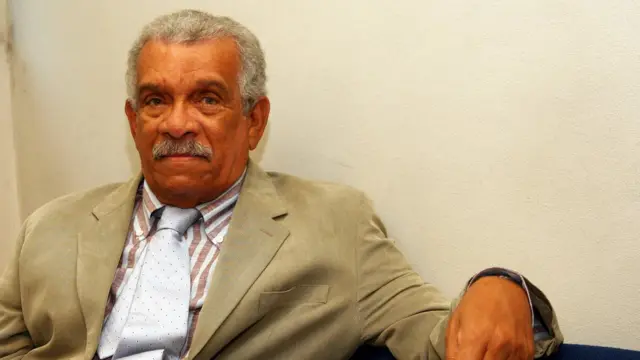
Design consultant and artiste Giovanni St Omer has reflected on the profound influence of Nobel Laureate Sir Derek Walcott on Saint Lucia’s cultural identity, while lamenting that many of the literary giant’s ambitions for the island’s arts landscape remained unrealized before his death in 2017.
The reflections came during an interview organized by the Government Information Service, which forms part of a wider effort to document the experiences and perspectives of Saint Lucian artistes whose lives and careers were shaped by Walcott’s legacy.
St Omer recalled first encountering Walcott as a child, through his close relationship with his father, renowned artist Sir Dunstan St Omer. He said those early interactions left a lasting impression.
“When I first met Derek, I must have been about five, six years old, and Derek would come by my dad and sit there, talk about the state of the arts, talk about politics,” St Omer said.
He explained that Walcott was part of a wider circle of creative thinkers and activists, including George Odlum, who believed strongly in the role of the arts in national development. According to St Omer, Walcott saw it as necessary to leave Saint Lucia in order to gain recognition abroad, before returning home to advocate effectively for the artistic community.
“He said you know I have to leave home to do what has to be done, and the thing is you have to go out there and make a name for yourself and then come back and then people will start to listen to the artistic community,” he recalled.
St Omer noted that, at the time, many local artisans and fine artists were marginalized and not taken seriously.
“The other artisans, the craftsmen and the fine artists and so forth, these were the pariahs. This is truth,” he said.
When Walcott returned to Saint Lucia, St Omer said his focus extended beyond elite circles to grassroots engagement within communities.
“When he came home he told my dad we need to go out into the community, we need to talk to these people, we need to make them see what Derek was trying to achieve, the recognition he was trying to get for Saint Lucia,” St Omer explained.
He said Walcott’s ultimate goal was to secure global recognition for the talent and creative capacity of Saint Lucians.
“He was trying to make the world recognize our talent and how great we are as a people,” St Omer added.
According to the design consultant, Walcott’s influence was not immediately recognized locally and only gained broader appreciation later, through the efforts of fellow artists and cultural advocates.
“Initially it was the politicians and the high-ups in society, and then he and my dad and the others, people like Robert Lee and Kendel Hipolyte, made people realize his influence and what he had done,” he said.
St Omer noted that Walcott believed Saint Lucia had reached a point where the world was watching, eager to see the next wave of creative talent emerge from the island.
“So, you piggyback on what he has done and then the world is looking at us now, looking to see who comes next, what comes next out of Saint Lucia,” he said.
However, St Omer said Walcott remained deeply disappointed that key cultural infrastructure projects were never realized. He revealed that even in the final years of his life, Walcott was still advocating for the same vision he had articulated decades earlier.
“Up to two years before Derek passed, Derek said the same thing that was said in 1982, 1983, that he wanted a theatre and Cultural Centre,” St Omer said.
He described this unfulfilled aspiration as one of Walcott’s greatest laments, underscoring the gap between his expansive vision for the arts and the realities that persisted long after his global acclaim.
The interview forms part of ongoing efforts to preserve the reflections of Saint Lucia’s creative community and to highlight the enduring relevance of Sir Derek Walcott’s call for sustained investment in culture and the arts.