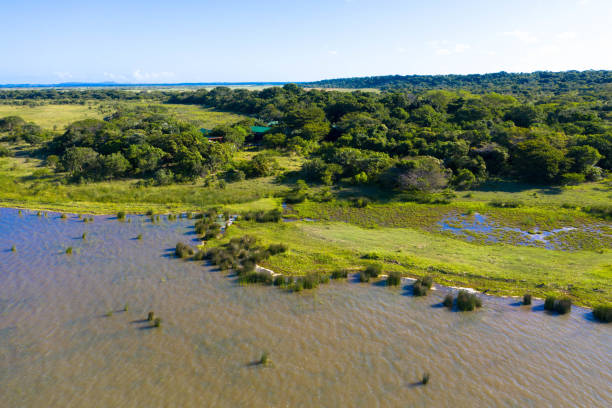
Forest Officer Karl Gustave is urging greater attention to the protection and management of Saint Lucia’s wetlands and forest ecosystems, warning that several environmental pressures are contributing to visible signs of ecological stress.
Speaking on the talk show Agriculture on the Move, Gustave outlined a number of natural and human-related factors affecting wetlands across the island, including sea level rise, land development, and water diversion.
“Things like sea level rise, which is a natural threat, are affecting our wetlands,” Gustave said.
He added that additional pressures are emerging which may be contributing to the dieback of mangroves and other wetland vegetation.
“We also have an emerging threat which, in some instances, may be causing some of the dieback that we are seeing. It’s a serious issue.”
According to Gustave, development activity within watersheds can alter natural water flow patterns that wetlands rely on for survival.
“Since we are constructing high up in the watersheds, we are changing the natural drainage patterns of the land,” he explained. “So, in some instances we may not be getting the level of recharge flowing to those wetlands that used to happen.”
He noted that infrastructure such as concrete drains and buildings can divert water away from ecosystems that depend on regular freshwater inflows.
“You also have the situation where you have abstraction for agricultural production where you may have too much abstraction beyond the point of the resource, beyond what is needed for the basic ecological services to be maintained,” he said.
“So, it’s affecting everything downstream.”
Gustave further explained that some wetlands depend on periodic interaction between freshwater systems and the sea. Natural barriers formed along beaches can sometimes prevent this exchange from taking place.
“In some instances, there has to be a natural recharge also from the sea,” he said. “If you have a berm created on the beaches and because you have less flow of the river the river cannot naturally burst that berm and allow the seawater to enter, then through management we may have to intervene.”
He suggested that controlled intervention may occasionally be necessary to restore natural water movement.
Addressing the problem will require coordinated management and collaboration among several government agencies responsible for land, water, and environmental protection.
“Because you have multiple agencies responsible for different things and no one overarching person or agency in charge to say okay we are doing this, it becomes difficult,” Gustave said.
He argued that stronger management frameworks and clear institutional responsibility are needed to protect the country’s remaining mangrove systems.
“To mitigate we would definitely have to rehabilitate and bring our remaining mangroves under better management,” he stated. “That requires a clear mandate as to who is responsible and empowering that person.”
Adequate funding will also be critical for long-term conservation efforts.
“There will also be the need for budgetary support as well,” Gustave said. “Sometimes we say management but then we give no budget. So, we now depend only on grants or attracting a project.”
Gustave emphasized that rehabilitation of degraded wetlands and expansion of mangrove areas where they historically existed should be part of the strategy going forward.
“Rehabilitate where needed and try to expand on the existing wetlands into areas that they used to historically occupy,” he said.
He also stressed that public education remains essential in protecting these sensitive ecosystems.
“Education is one of the key components in making people understand that you cannot go and clear cut the wetland just because you want to make some charcoal,” Gustave said.
Environmental experts note that wetlands play a crucial role in protecting coastlines, filtering water, supporting biodiversity, and reducing the impact of flooding, making their protection an important part of Saint Lucia’s broader environmental resilience efforts.