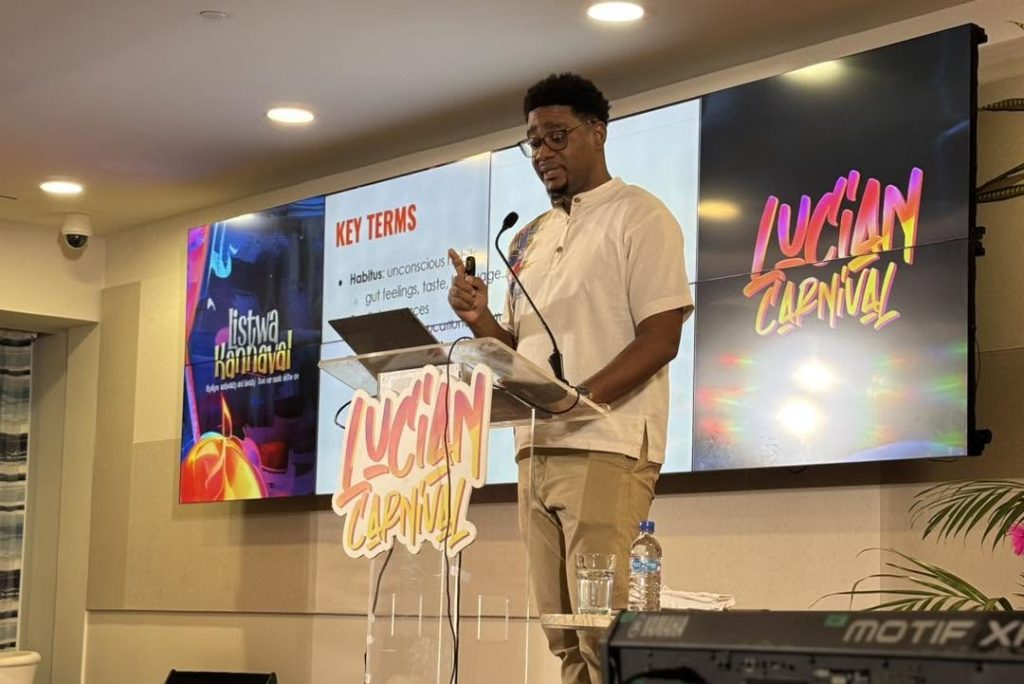
As Lucian Carnival 2026 gathers momentum, a recent cultural lecture hosted by the Carnival Planning and Management Committee (CPMC) turned the spotlight on the deeper significance of Saint Lucian music, examining how rhythm, language and cultural traditions shape national identity.
The discussion formed part of the return of Listwa Kanaval, held on June 10 under the theme “Rhythm, Authenticity, and Identity: Does Our Music Define Us?” The event featured a presentation by academic Dr Ronald T. Francis, who explored the origins and cultural foundations of Dennery Segment, one of Saint Lucia’s most recognizable musical genres.
Dr Francis traced the emergence of the genre to a new generation of young producers working outside the traditional music establishment.
“It emerged on the island, it really got prominence somewhere in the early 10s, and it was created by young producers, this is key, who were working in home studios and using accessible software such as FL Studio,” he explained.
According to Francis, these producers lacked access to expensive equipment and formal industry networks but succeeded in creating a musical movement that resonated with communities across the island.
“So they did not have equipment, and they were not part of the established music elite. So they were doing music for themselves and for their communities, and it gained traction through house parties, street parties, clubs, etc., mostly on the east coast of Saint Lucia, spreading to the west coast of Saint Lucia over time, and then it eventually became popular.”
He described the genre as distinctly local in both content and character.
“So it is Saint Lucian made, it is about Saint Lucian life, and it is authentically Saint Lucian,” Francis said.
The lecturer argued that the authenticity of Dennery Segment stems from its use of local language, traditional influences and depictions of everyday life.
“Authentically Saint Lucian simply means that they feature traditional Saint Lucian instrumentation,” he noted. “It features Creole lyrics, the strongest symbol of Saint Lucian identity, you’d agree, and it also features aspects of Saint Lucian culture.”
Francis said his research found strong evidence that the genre draws heavily from the island’s cultural traditions.
“The lyrics feature Creole lyrics, that the instrumentation is connected to Saint Lucian folk culture, and many aspects of Saint Lucian culture and life, particularly rural life, are present in the lyrics,” he explained. “So that is why we are looking at rhythm, language, and cultural practice today.”
A significant portion of the presentation focused on the role of language in shaping the genre’s identity. Francis challenged the misconception that Creole is somehow inferior to other languages.
“In Creole languages, and this again I cannot stress enough, is not broken. It is different, not deficient,” he told the audience.
He explained that many of the grammatical structures heard in Dennery Segment lyrics are standard features of Saint Lucian Creole and English Creole rather than mistakes or deviations from English.
“Basically, Creole and Saint Lucia English Creole, the languages of Saint Lucia, that is what is in the lyrics that we see,” Francis said.
He argued that artists are naturally expressing the language and experiences that form part of their daily lives.
“They’re singing what they know. They’re literally singing their linguistic competence, the languages that they know,” he said. “And what they know is what they produce. And thankfully, what they know is Saint Lucia.”
At the same time, Francis noted that performers also make deliberate choices to emphasize their cultural identity through music.
“There is also a conscious act,” he said. “They’re making choices as well to imbue the lyrics with a particular identity.”
Turning to the musical characteristics of Dennery Segment, Francis cited observations from prominent producer Motto, who has been widely credited with helping define the genre’s sound.
“So the question is, rhythmically, what’s in Dennery Segment?” Francis asked. “Well, Motto, who is perhaps the biggest producer in Dennery Segment, he tells us, he says anything above 140 beats per minute can be considered Lucian Kuduro.”
He explained that the genre differs from traditional Soca through its emphasis on percussion and rhythm rather than melodic arrangements.
“Other Soca is more melodic. There are more chords and arrangements, but Lucian Kuduro only has one lead instrument, and that’s generally the drum,” Francis noted while summarizing Motto’s description of the style.
He added that the genre relies heavily on drums, lead instruments and bass rather than complex chord progressions.
The presentation formed part of broader efforts by the CPMC to encourage discussion about the cultural foundations of carnival and the role that music continues to play in preserving and expressing Saint Lucian identity.