

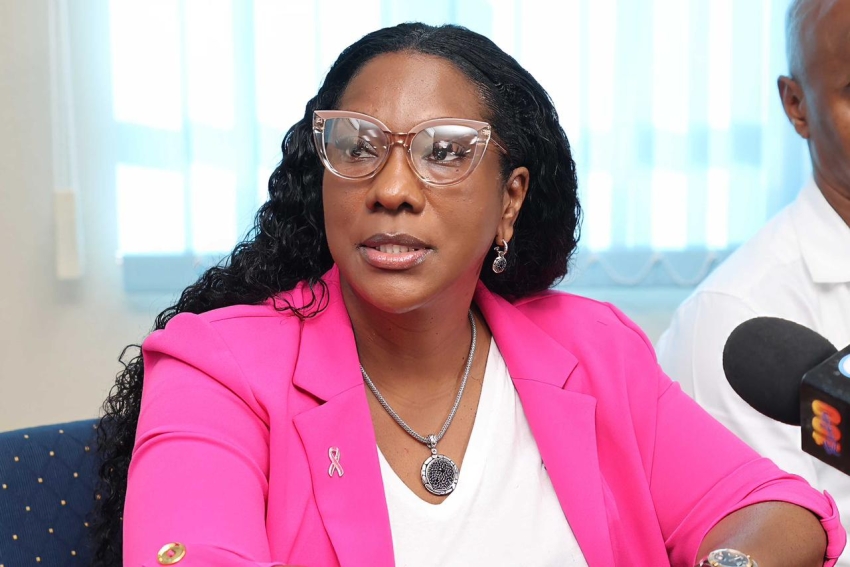
Water security and infrastructure took center stage as the Saint Lucia Chamber of Commerce hosted an executive luncheon, bringing members face-to-face with the Water and Sewerage Company to discuss the future of water services in Saint Lucia.
The session provided an opportunity for business leaders to engage directly with officials, raising concerns and seeking clarity on plans to modernize systems and ensure a more reliable supply.
Chamber President Nicholas Barnard acknowledged that public perception of the utility has not always been positive but suggested that discussions at the forum painted a more structured picture.
“Sometimes there is a perception that WASCO is disorganized or not fully in control,” Barnard said. “But it seems to me that they have everything under control, and they know exactly what direction to take.”
He emphasized the importance of the engagement, noting that water access remains critical across all sectors.
“We allowed our members to engage directly with WASCO so they could ask those very hard questions,” he explained. “We need water for all our businesses, whether in hotels, manufacturing or other services. We need water for our staff and for production.”
Chief Executive Officer of WASCO, Zilta George-Leslie, outlined the company’s long-term vision, describing it as both ambitious and essential.
“The vision is simple but ambitious, safe, affordable and sustainable water and sanitation services for all communities,” she said. “Our mission is to deliver this through resilient infrastructure, appropriate technology and the expertise of our human resources.”
George-Leslie highlighted the island’s heavy reliance on rainfall as a key challenge in maintaining a consistent supply.
“Every drop of water that comes out of our taps started as rain that fell on our mountains and hillsides,” she explained. “We have no significant groundwater aquifers or large-scale desalination infrastructure. We are, in every sense, rain-fed.”
She also detailed several major infrastructure projects aimed at improving supply and efficiency across the island.
“We are starting with five kilometers of raw water pipeline in the Millet area, which will feed into the Theobalds treatment plant,” she said. “We will rehabilitate that plant, where filters are currently operating at 40 per cent efficiency.”
Plans are also underway to expand treatment capacity. “We have six filters that we would like to bring into operation within the next 24 months,” she added.
In addition, WASCO is preparing to roll out the Northern Pipeline project, designed to improve distribution in key areas.
“That pipeline will run from Bonne Terre Gap to Gros Islet, and with that improvement, we expect to see a significant boost in water supply to the north,” George-Leslie noted.
She concluded that these combined efforts are expected to deliver tangible improvements. “Together, these projects will enable us to have a greater supply of water available to the citizens of Saint Lucia.”
The forum forms part of ongoing dialogue between the public and private sectors, as stakeholders work towards ensuring a more resilient and efficient water system to support national development.