

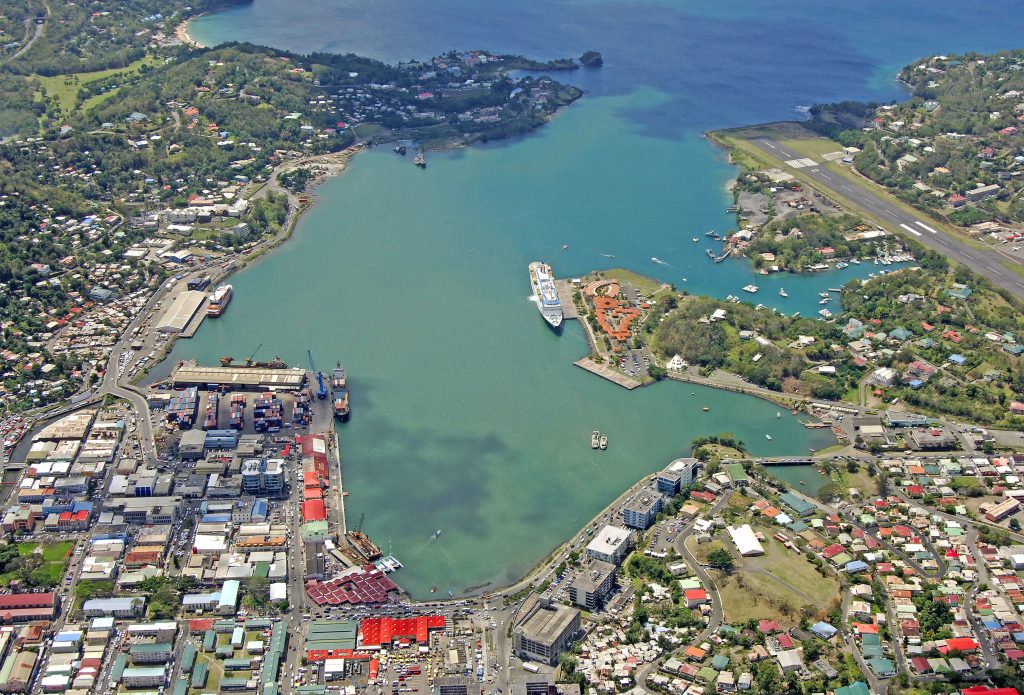
Saint Lucia’s business community is warning that persistent delays at the nation’s ports are imposing significant costs on economic activity, even as the Customs and Excise Department moves ahead with plans to modernize and streamline clearance systems.
At a meeting on June 11, the Chamber of Commerce pressed customs officials on long-standing bottlenecks affecting imports and exports, arguing that inefficiencies at ports of entry continue to ripple across the wider economy.
Executive Director of the Chamber of Commerce, Brian Louisy, underscored the central role of ports in national development.
“More than 90% of all our economic activity goes through our ports of entry, be it airport or seaport,” Louisy said. “Therefore, Customs and Excise Department and the Air and Seaport Authority have a disproportionate impact on what happens in the rest of the economy.”
His remarks emphasized growing concern among private sector stakeholders that delays in clearance processes are undermining productivity, increasing operational costs, and affecting supply chains.
Comptroller of Customs, Sherman Emmanuel, acknowledged the challenges highlighted by industry, pointing to findings from a time-release study that exposed systemic inefficiencies.
“It is quite clear from the time-release study that clearance times were too long, with processes fragmented across multiple actors in the clearance process,” Emmanuel said.
He described the study as a key turning point in the department’s reform agenda.
“So that time-release study was, I suppose you could say, the first kicker or indicator,” he explained. “Not that we did not already know that we needed to be more efficient in terms of the clearance process. But the time-release study provided the data to support that.”
According to Emmanuel, the findings have strengthened the case for ongoing reforms aimed at reducing delays and improving coordination among agencies involved in cargo processing.
Also addressing stakeholders was Inspector Gilroy Polius, Head of the Risk Management Unit at the Customs and Excise Department, who highlighted the growing uptake of digital payment systems but noted that adoption among businesses remains limited.
“One of the things that came up was the fact that we seem to have about a 20% increase with the individual online payments, but there has not been much movement with the business community,” Polius said.
He urged greater participation from companies in utilizing available digital platforms, arguing that efficiency gains depend on broader uptake.
“And again, that is why I said that you need to exploit this,” he stated. “You need to pay attention and take advantage of that facility which is there for you.”
The engagement comes as Customs continues to advance its digital transformation strategy, which officials say is designed to reduce clearance times, improve transparency, and modernize trade facilitation processes.
However, for many in the private sector, the key concern remains whether reform efforts will translate into tangible improvements at the ports, where delays continue to affect the cost and ease of doing business in Saint Lucia.