

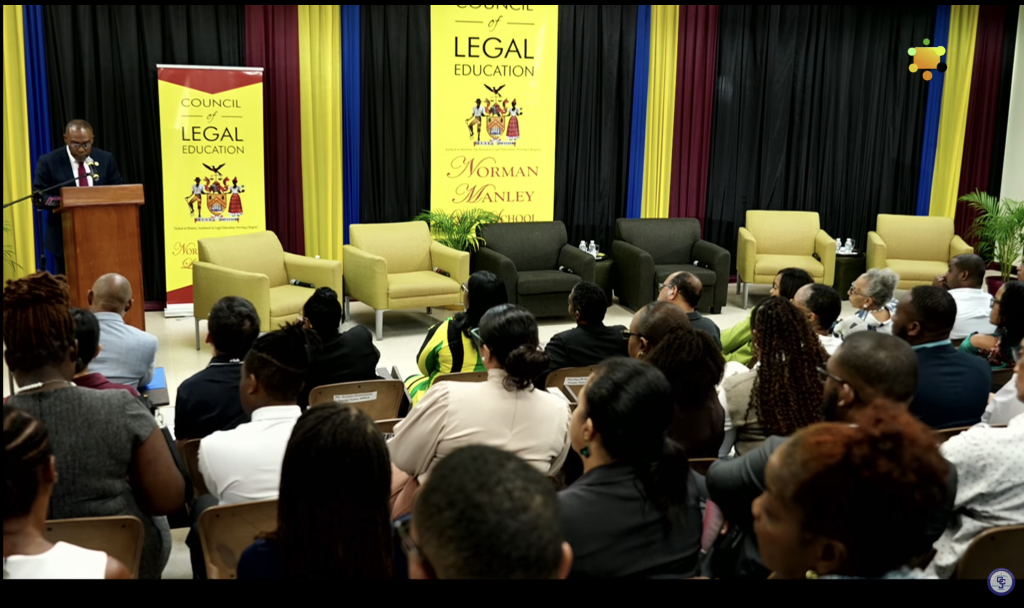
The legal challenges surrounding the use of nuclear weapons came under scrutiny on August 4 as the Judicial Education Institute, in collaboration with the Norman Manley Law School in Jamaica and the Caribbean Court of Justice (CCJ), hosted a lecture examining whether international law provides a clear framework on the issue.
The lecture, held under the theme “The New Freedom Lecture! No First Use of Nuclear Weapons: The Limits of Law?”, featured President of the CCJ, Justice Winston Anderson, as the keynote speaker.
Justice Anderson, whose court serves as Saint Lucia’s final appellate court, examined the international treaties governing nuclear weapons and identified what he described as fundamental weaknesses within the existing legal system.
He pointed to the Nuclear Non-Proliferation Treaty (NPT) as a central instrument in regulating nuclear weapons but argued that gaps within the treaty have limited its effectiveness.
“There are 191 state parties to the Non-Proliferation Treaty,” Justice Anderson said.
He noted that the five states recognized under the treaty as nuclear weapon states are also permanent members of the United Nations Security Council.
“The five states that manufactured and exploded a nuclear weapon or a nuclear device before January 1, 1967 are parties, US, Russia, UK, France, and China. They also happen to be the permanent members on the United Nations Security Council.”
Justice Anderson identified what he described as two major design flaws within the current international framework.
“Design flaw one,” he said, relates to allegations that nuclear technology has been transferred by some nuclear states to other countries, while international enforcement mechanisms remain limited.
“There are persistent reports that some among the five nuclear states have shared or are sharing weapons technology with other non-nuclear states.”
“But neither the Jamaica Constabulary Force nor any other domestic police force has powers to investigate, and no courts can enforce any breach of the treaty.”
He also highlighted the absence of several nuclear-armed states from the Non-Proliferation Treaty.
“Design flaw two. Several nuclear weapons states have not joined the Nuclear Non-Proliferation Treaty. India, Pakistan, and Israel have not joined. North Korea joined in 1985 but withdrew in 2003.”
According to Justice Anderson, these countries are therefore not bound by the same obligations under the treaty.
“These states, therefore, have no non-proliferation, disarmament, or peaceful use obligations under the treaty.”
In concluding his remarks, the CCJ President said international law has yet to provide a definitive answer on the legality of nuclear weapons use.
“So, in summing up, 30 years after the ICJ advisory opinion in 1996, international law still has no clear answer to whether it’s legal or illegal to use nuclear weapons.”
He argued that structural weaknesses within international relations continue to complicate efforts to resolve the issue.
“As shown, there are certain deep-seated design flaws in the infrastructure of international legal relations that make it difficult, if not impossible, to give a straight answer to that question.”
Saint Lucian Rhodes Scholar Rahym Augustin-Joseph participated in the discussion as a panelist, offering a youth perspective on the global implications of nuclear weapons and international decision-making.
Augustin-Joseph argued that weaknesses within global governance structures have contributed to a system that often excludes smaller states from meaningful participation.
“Whether it is the veto power at the United Nations Security Council, whether it is the lack of representation for countries that have millions of people but also have been always left out of the conversation because we do not believe that these countries have a voice at international fora,” he said.
He said young people, particularly those in the Global South, are calling for reforms to create a more balanced international system.
“All of these things are inbuilt defective parts of the system that young people across the world, particularly in the global south, are saying needs to be part of a new international rules-based order.”
According to Augustin-Joseph, this new framework should focus not only on punishment and power but also on cooperation and peace.
“A new international rules-based order that isn’t only going to be punitive but that creates a new version of leadership around the world that understands that peace must prevail over war in many instances.”
The Rhodes Scholar also challenged the perception that young people are disconnected from major geopolitical issues, arguing that conflicts involving major powers have direct consequences for Caribbean societies.
“The young people of the Caribbean and the wider world are not uninterested in wider geopolitical machinations or the ability of superpowers to move at lightning rapidity.”
However, he said there is concern that the Caribbean does not always recognize how global conflicts can affect everyday life in the region.
“What worries me is our inability at times to see the interconnectedness of nuclear fights on the wider Caribbean region.”
He pointed to economic consequences as one example of how international conflicts can affect Caribbean citizens.
“So whether it be the cost of fuel, whether it be less tax revenue for government, so therefore they can’t invest in social spending to give young people deposits to pay houses, or it could be a multiplicity of other priorities that happen as a result of big powers fighting.”
Augustin-Joseph said young people around the world are increasingly demanding that peaceful solutions replace military confrontation.
“Young people are not uninterested.”
“And whether it is that we see across the world young people taking a much greater place at the front through active protest and making the argument that there has to be a world in which peace prevails over war.”
He added that the discussion ultimately reflects a broader question about whether countries can work together to address global challenges.
“But this entire conversation always rests or rested rather on the sort of liberal IR assumption, which is that states would work together to be able to operate and deal with their issues.”
The lecture provided a platform for legal experts, academics and young leaders to examine the limits of international law and the need for greater cooperation in addressing some of the world’s most pressing security challenges.