

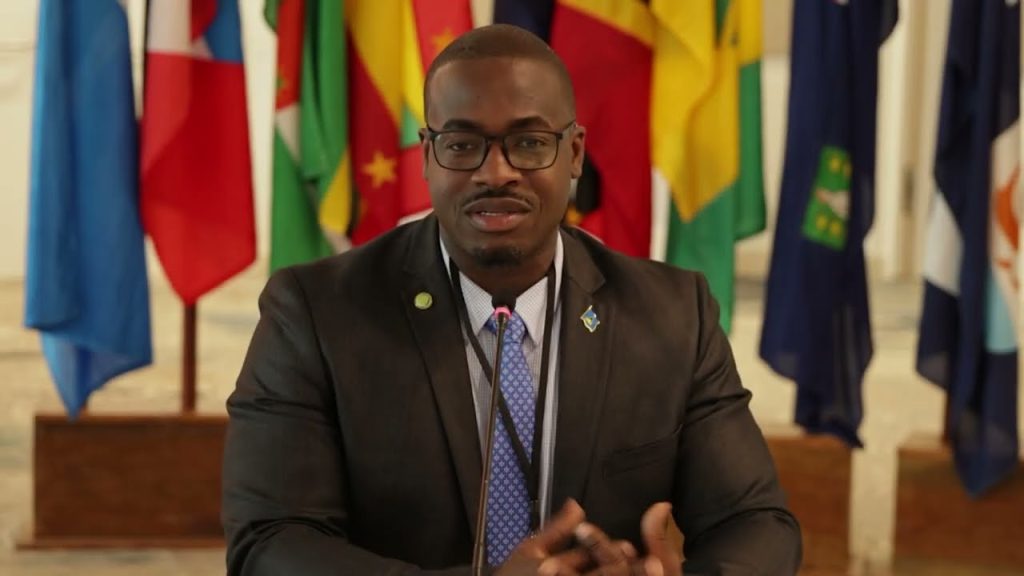
Minister for Education, Youth Development and Sports Kenson Casimir is encouraging Saint Lucians of all ages to embrace reading during the internationally recognized Reading Month, while also addressing concerns and criticisms surrounding the recently concluded Caribbean Primary Exit Assessment examinations.
Speaking during the May 18 pre-Cabinet press briefing, Casimir stressed that reading should not be viewed as an activity reserved only for children, but as an essential habit for adults seeking to better understand the world around them.
“Reading month should not just be considered for the children. Our adults need to read,” the minister stated.
Casimir expressed concern about what he described as declining levels of reading comprehension and critical thinking, particularly in an era dominated by social media commentary and online influencers.
“I seriously believe there is a problem with reading, comprehension, understanding, and not just waiting for individuals in the social sphere, influencers to tell you what to think, but to think for yourself,” he said.
The minister urged members of the public to engage more deeply with information before rushing to conclusions.
“Read the entire release, the entire statement of a video before prejudging,” Casimir advised.
He also encouraged teachers, principals and parents to use Reading Month as an opportunity for self-development and adaptation to modern educational realities.
“So I made the call for adults to really use this month to read,” he said. “Read something, whether you’re a teacher, a principal, read something that can help you with reskilling and adjusting to this new generation.”
Casimir added that literacy and reading habits must be promoted across all sectors of society.
“And so I want to take this opportunity to encourage everybody, parents, teachers, and children to get more involved in reading,” he remarked.
The minister also addressed public discussion surrounding the recently held Caribbean Primary Exit Assessment examinations conducted on May 13 and 14.
Casimir explained that the region had already moved away from the older Common Entrance examination model, where a student’s placement into secondary school depended entirely on a single examination day.
“We saw the move from having CPEA or what we call common entrance one day as the determinant of an individual’s position or placement at a secondary school,” he explained.
“Of course, there was thorough discussion on whether one day should justify what secondary school a child attends.”
He noted that the current CPEA model now incorporates both continuous assessment and examination performance.
“That was definitely adjusted to ensure that you have a component which is 40 percent similar to SBA completion towards year green, which one may describe as some level of continuous assessment,” Casimir stated. “And of course, the other 60 percent being on the day, the multiple-choice questions in the different academic fields.”
However, the minister indicated that he personally believes education systems should move beyond a heavy reliance on examinations alone.
“I can tell you that I am not one who gravitates towards just examination,” Casimir said. “I believe we need to, from that age, be dealing with children as developing professionals.”
According to Casimir, education should focus on preparing students for life, employment and meaningful participation in society.
“Education should always be in life forming in terms of transitioning children through the phases in terms of their adopting life skills that can be sustained for their employment,” he explained. “That could be sustained in terms of the individuals in our society that is progressive and providing that level of economic activity for the wider nation.”
The minister said the education system would continue to evolve through ongoing reviews and discussions aimed at improving student development and learning outcomes.
“We’ll obviously see how we can ensure we have that evolution in education that really deals with the child becoming more productive citizens and not necessarily just strictly examinations to determine somebody’s ability to function in the work world.”