

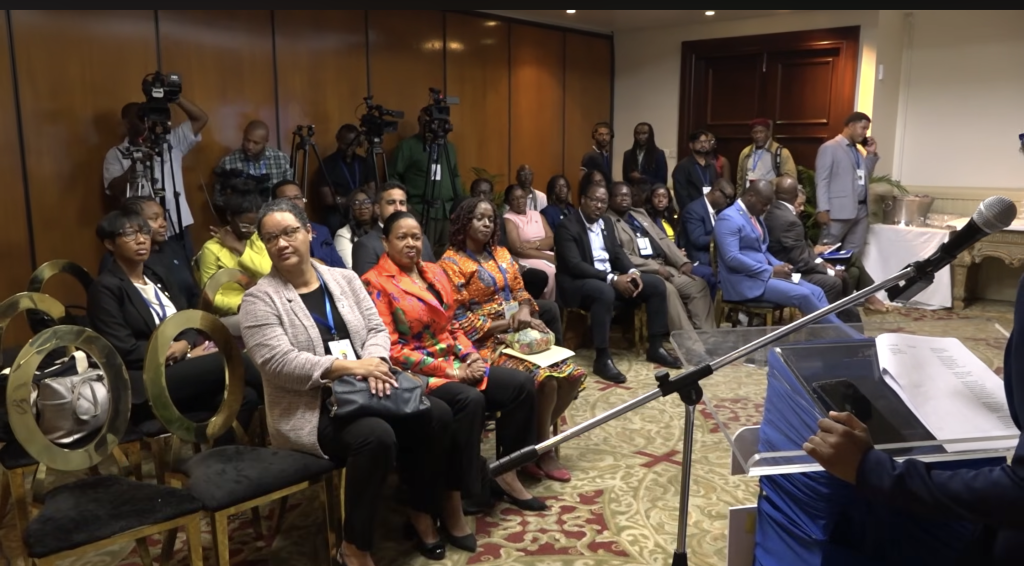
The future of regional integration took center stage on Monday as young leaders from Saint Lucia and across the Caribbean gathered for the CARICOM Youth Forum, calling for greater youth participation in shaping the future of the Community.
Held alongside the 51st Regular Meeting of the Conference of CARICOM Heads of Government, the forum was jointly hosted by the Government of Saint Lucia and the CARICOM Secretariat under the theme “Youth Solutions for the Future.” The hybrid event brought together participants virtually and in person to discuss regional challenges and propose practical solutions to strengthen CARICOM’s relevance to young people.
CARICOM Youth Ambassador for Saint Lucia, Shelly Desir, said the region’s youth are already playing an active role in building the Caribbean’s future despite the many challenges confronting them.
“Caribbean young people are not waiting to inherit the future. We are helping to build it today,” Desir declared.
She noted that young people continue to grapple with a range of social, economic and environmental issues that require urgent regional attention.
“Across our region, we continue to face significant challenges. Climate change threatens our communities. Economic uncertainty affects our opportunities for young people. Crime and violence impact our sense of safety,” she said.
Desir also highlighted the obstacles many young Caribbean citizens encounter as they seek opportunities for advancement.
“Many young people continue to experience barriers to employment, entrepreneurship, regional mobility, and meaningful participation in decision-making,” she added.
Minister for Youth Development Kenson Casimir reaffirmed the commitment of Caribbean governments to ensuring that young people are directly involved in shaping the region’s future.
“Our collective conviction as Caribbean governments is simple. The future of CARICOM will not be built for young people. It will be built with them,” Casimir said.
He described forums such as this as essential opportunities for meaningful engagement between policymakers and the region’s youth.
“This is why dialogues such as this are so significant. They offer far more than opportunity for discussion. They create meaningful spaces for collaboration, networking, partnership between those who shape public policy and those whose futures will be most directly influenced by the decisions we make,” he stated.
Casimir also called for a broader understanding of education and success, arguing that the Caribbean must move beyond traditional definitions of achievement.
“Education itself must continue to evolve. We must move beyond the outdated notion that success is defined only by a university degree or profession behind an air-conditioned office desk,” he said.
Instead, he urged greater recognition of technical, vocational and creative pathways.
“We must embrace what is described as parity of esteem, recognizing that academic achievement, technical and vocational education, digital skills, entrepreneurship, the creative industry and sport are all equally viable pathways to success,” Casimir said.
The forum formed part of broader efforts by CARICOM to deepen youth engagement in regional affairs and ensure that the voices of young Caribbean citizens are reflected in policies shaping the Community’s future.