

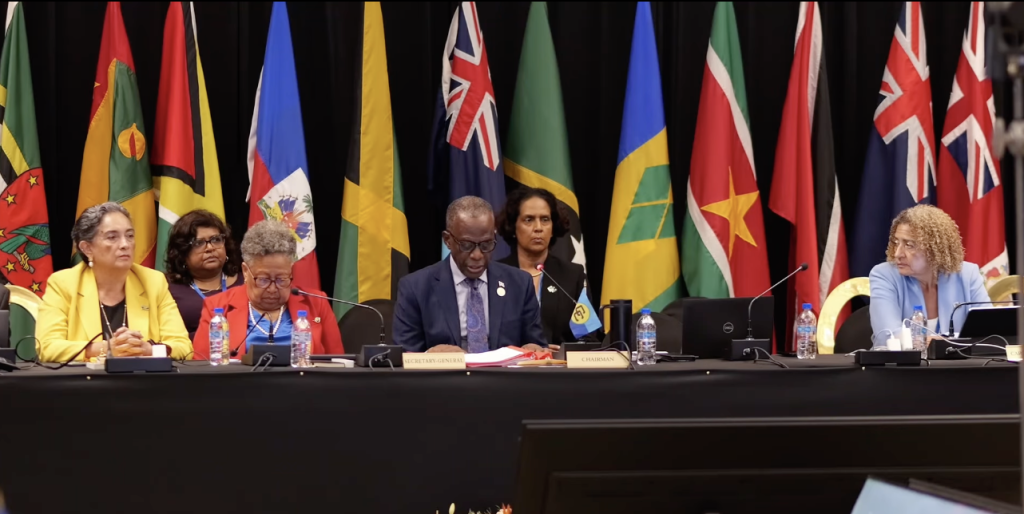
Caribbean Community (CARICOM) Heads of Government have agreed to seek an advisory opinion from the Caribbean Court of Justice (CCJ) regarding the process used to reappoint CARICOM Secretary-General Dr Carla Barnett for a second five-year term.
The decision follows objections raised by Trinidad and Tobago over the procedure used in Barnett’s reappointment. Addressing reporters on Tuesday, CARICOM Chairman, Prime Minister Philip J Pierre, said regional leaders had agreed on a legal path forward that preserves unity while allowing the issue to be resolved through the Community’s highest treaty interpretation body.
Pierre said Trinidad and Tobago had maintained its position on the matter.
“The Republic of Trinidad and Tobago maintained its objection to the process used in the reappointment of the Secretary-General of the Caribbean Community, CARICOM,” he stated.
He said the Community acknowledged Trinidad and Tobago’s request to refer the matter to the Caribbean Court of Justice.
“CARICOM acknowledged that the Republic of Trinidad and Tobago desires to have the issue of the reappointment of the Secretary-General referred to the Caribbean Court of Justice (CCJ) to render an advisory opinion thereon.”
To facilitate that request, Pierre said the regional bloc had agreed to initiate proceedings under the provisions of the Revised Treaty of Chaguaramas.
“To facilitate this request, the Community agrees to commence proceedings to secure such advisory opinion in accordance with Article 212 of the Revised Treaty of Chaguaramas,” he said.
Pierre noted that the referral aligns with the role for which the CCJ was established.
“The Community acknowledged that this is the very purpose for which the CCJ was created, to be a treaty interpretation body.”
Pending the Court’s opinion, Barnett’s reappointment will remain in effect.
“The Community further agreed that the status quo with respect to the reappointment of the Secretary-General shall remain unless and until the Community considers the said advisory opinion from the CCJ,” Pierre said.
He described the agreed approach as one that would allow the matter to be settled without disrupting the work of the regional organization.
“The community agreed that this way forward allows for this matter to be resolved in an amicable manner without prejudice to the ability of the community to conduct its affairs.”
Pierre also linked the issue to CARICOM’s ongoing efforts to strengthen its governance framework.
“In this context, the community reaffirmed that the ongoing review of the governance architecture is part of the broader mandate agreed at the previous conference in St. Kitts and Nevis to strengthen the governance of the community and enhance its effectiveness,” he said.
He stressed that the governance review was not directed against any member state or individual but reflected CARICOM’s commitment to institutional development.
“The heads further underscored that this process does not infringe the integrity of any member, state or individual, but rather it reflects the community’s collective commitment to continuous institutional improvement with the highest standards of good governance.”
Pierre said CARICOM leaders remained united despite the disagreement and committed to advancing the interests of the region.
“The heads have reaffirmed their commitment to the ideas and objectives of the community and will continue to move forward in unity to advance the interests of the region during these difficult times, recognizing the myriad of challenges the community faces currently,” he said.