
Regional tax administrators are urging greater innovation, collaboration and investment in modern tax systems as Caribbean governments respond to an increasingly complex global fiscal environment.
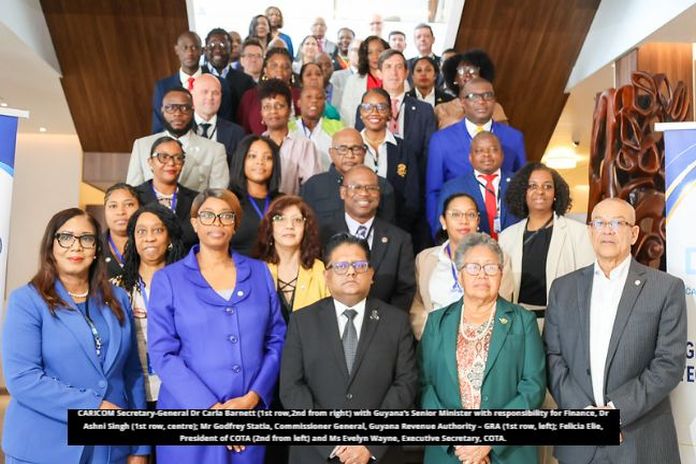
The call came during the opening of the 27th General Assembly and Technical Conference of the Caribbean Organization of Tax Administrations (COTA) in Guyana, where delegates highlighted the importance of strengthening tax administration to support sustainable economic development and improve public revenue collection.
COTA President Felicia Ellie, who is also the Acting Comptroller of Saint Lucia’s Inland Revenue Department, said tax administrations throughout the region are facing unprecedented challenges driven by technological advances, changing business practices and rising public expectations.
“We operate in an increasingly complex environment where technological innovation, changing taxpayer expectations, emerging business models, and growing demands for public services require us to rethink how we administer our tax systems,” Ellie said.
She noted that, regardless of their size or level of development, tax authorities across the Caribbean share many of the same objectives.
“All tax administrations, whether we are large or small, whether we are more advanced or less advanced, we want to improve compliance. We want to simplify our processes. We want to harness the technology that is at hand,” she said.
Ellie also stressed the importance of encouraging taxpayers to meet their obligations promptly.
“And somehow, all of us want to convince our taxpayers that filing on time is better, or filing earlier, I should say, is better than waiting at the last minute,” she added.
Despite the increasing role of digital technology, Ellie said collaboration among tax professionals remains essential.
“No matter how advanced our technology becomes, there is still no substitute for leaders, for colleagues to share ideas,” she said. “There is no substitute for us to build relationships and occasionally to borrow a good idea from a colleague. After all, when we share good ideas, they multiply.”
She expressed confidence that the conference would generate lasting benefits for tax administrations throughout the region.
“I am confident that this conference will produce meaningful insights, strengthen our partnerships and inspire innovative approaches that will benefit our respective administrations long after we return home,” Ellie said.
Secretary General of the Caribbean Community (CARICOM), Dr Carla Bennett, said the region must continue adapting to rapid changes in the international tax environment.
“The international tax environment continues to change,” Bennett said.
She pointed to evolving international standards on tax transparency, exchange of information, beneficial ownership, digitalization and the taxation of multinational enterprises as factors reshaping global fiscal policy.
“New and evolving standards relating to tax transparency, including exchange of information, beneficial ownership, digitalization, and the taxation of multinational enterprises, continue to reshape the global fiscal landscape,” she said.
Bennett acknowledged that keeping pace with these developments presents particular challenges for small island developing states.
“For small developing states with limited administrative resources, keeping pace with these changes requires continuous institutional strengthening, investment in human capital, and sustained regional cooperation and collaboration,” she said.
The conference brings together tax administrators and policymakers from across the Caribbean to examine emerging trends in tax administration, share best practices and explore strategies for improving efficiency, compliance and regional cooperation.