

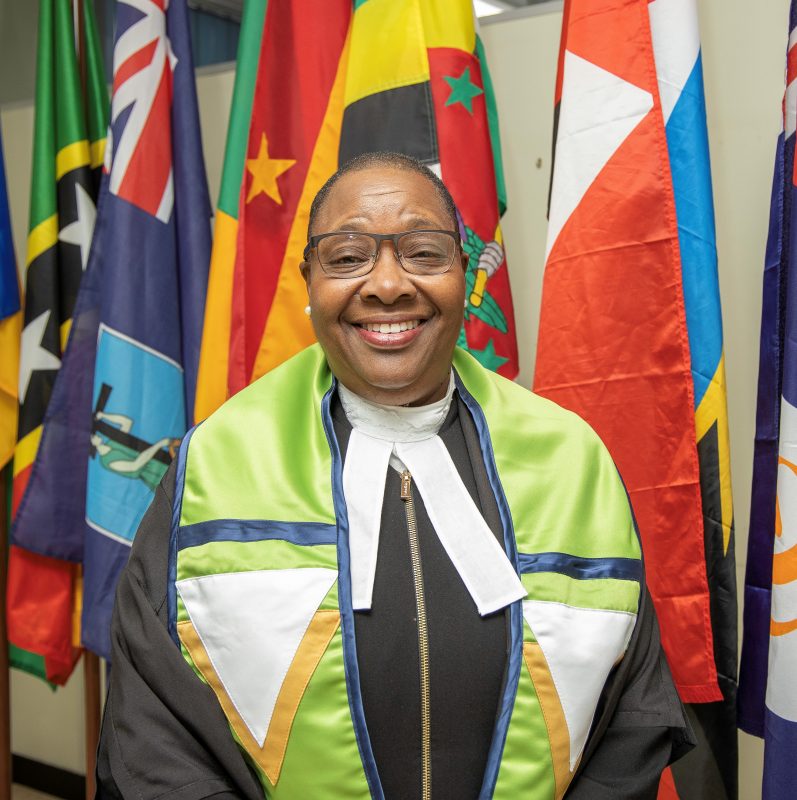
Acting Chief Justice of the Eastern Caribbean Supreme Court, Margaret Alison Price Findlay, has underscored the importance of judicial independence, integrity and public engagement, as she was featured in a special interview marking International Women’s Day.
Born in Diego Martin, Trinidad and Tobago, Justice Price-Findlay received her early education at the Holy Name Convent Secondary School before pursuing legal studies at the University of the West Indies, Cave Hill Campus in Barbados, where she earned a Bachelor of Laws degree with honours in 1985. She later attended the Hugh Wooding Law School, obtaining her Legal Education Certificate in 1987, the same year she was called to the Bar of Trinidad and Tobago.
Her legal career began as an associate at the law firm of James Brathwaite between 1987 and 1988. She was appointed a High Court Judge in 2009, serving in Grenada, before being assigned to Saint Lucia from 2015 to 2022, where she presided in the Criminal Division of the High Court. In September 2022, she was elevated to the Court of Appeal Bench, bringing extensive experience in both trial and appellate jurisdictions.
Reflecting on her current role, Justice Price-Findlay described the unique challenges of leading a regional judiciary that spans multiple jurisdictions.
“You are the head of the judiciary and also the face of the judiciary,” she said. “Unlike any other Chief Justice in the Caribbean, you preside over nine states and territories.”
She noted that the position requires a high level of diplomacy and engagement with a wide range of stakeholders.
“You deal with nine Prime Ministers, nine Directors of Public Prosecutions and nine Solicitors General,” she explained. “It causes you to be very diplomatic and to learn how to approach each individual and each situation with tact.”
Justice Price-Findlay added that achieving consensus across jurisdictions is often complex.
“All nine states and territories are not always on the same page,” she said. “It requires a lot of interaction, networking and discussion to get certain things done.”
On the issue of judicial independence, she stressed that maintaining public confidence in the justice system is paramount.
“Judicial independence is important because at the end of the day we serve the public of the Eastern Caribbean,” she said. “The public has to have confidence in the judicial system.”
She emphasised that decisions must be guided by law and principle rather than popularity or personal relationships.
“You do not make a decision that is popular. You make a decision that is right,” she stated. “You do not favour somebody because they are your friend. You make the decision because it is the right thing to do.”
Justice Price-Findlay credited the strength of the court to the calibre of its judicial officers over the decades.
“We have been very fortunate in recruiting men and women who have brought to the bench the highest ideals of integrity and honesty,” she said.
While acknowledging that the judiciary is sometimes subject to criticism, she pointed to established avenues for appeal within the legal system, including the Caribbean Court of Justice and the Judicial Committee of the Privy Council.
“If a decision is not correct or you are aggrieved, you have the option of going to a higher court,” she noted.
Justice Price-Findlay also highlighted the need for greater public understanding of how the courts operate.
“I think sometimes members of the public do not necessarily understand how exactly a court functions,” she said. “It may be for the court to have more public outreach and to explain how our processes work.”
As the Eastern Caribbean Supreme Court approaches its 60th anniversary, Justice Price-Findlay expressed confidence in the institution’s future, grounded in its continued commitment to fairness, integrity and service to the public.