

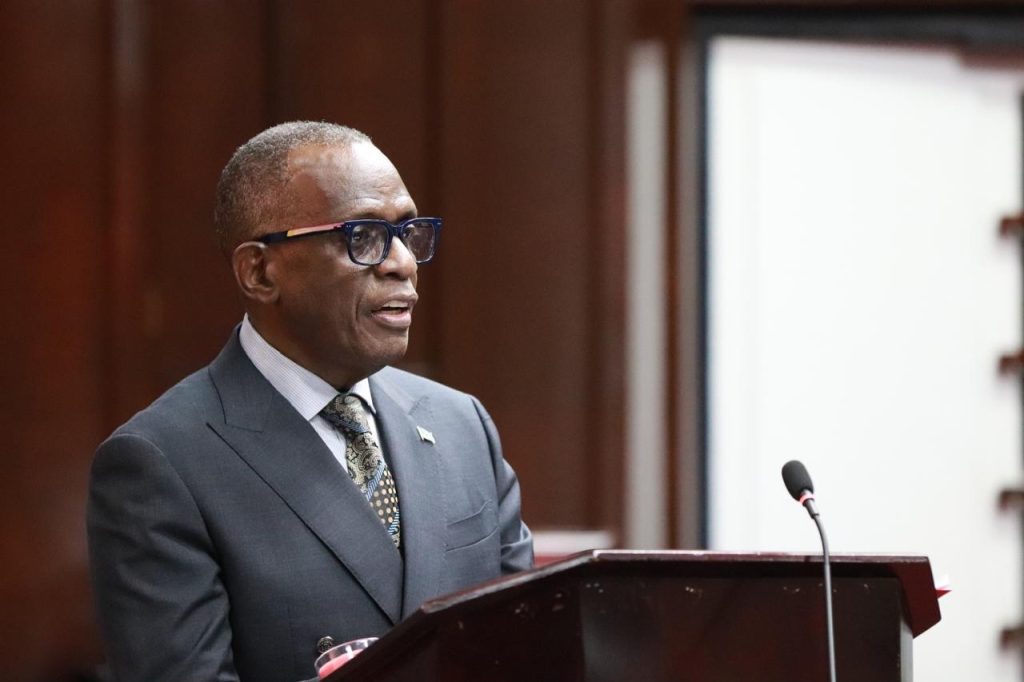
Prime Minister Philip J. Pierre has presented the 2026–2027 Appropriation Bill, setting out an agenda focused on infrastructure expansion, social support, youth development, and economic resilience in Saint Lucia.
Delivering his policy statement in the House of Parliament of Saint Lucia on April 21, Pierre said the government’s approach is guided by the theme “Consolidating Our Gains; Prospering In Uncertain Times”.
“In the last two budgets, we allocated a considerable amount of resources in infrastructure development,” he stated. “This fiscal year, we will advance work on some road infrastructure projects, having secured the required finance, road designs, and plan approvals.”
Among the flagship initiatives is a major upgrade to the northern road corridor. Pierre confirmed that preparatory works have been completed and construction will proceed in phases.
“We have completed the upgrade and rehabilitation of the Vieux Sucrieux/Norbert Road in preparation for major works from Choc to Gros Islet,” he said. “The road will be constructed in three sections… construction will begin from Monchy to Gros Islet.”
He disclosed that financing has already been secured through international partnerships. “A loan agreement was signed on 13 October, 2025 with the Kuwaiti Fund for Arab Economic Development in the amount of four million Kuwaiti dinars,” Pierre explained, adding that additional loan agreements totaling EC$56.3 million have also been finalized.
The project will include expanded infrastructure and safety features. “The construction will include upgrading of the existing roadway… into a dual carriage, sidewalks, four pedestrian overhead crossings, and three roundabouts,” he noted.
On water security, the Prime Minister indicated that reforms are underway at the Water and Sewerage Company.
“The entire administration of WASCO will come under review,” he said, revealing that the Cabinet has appointed a committee to work with the International Finance Corporation to develop a public-private partnership framework.
In the interim, several projects will proceed, including improvements to rural water supply.
“The Patience Water Supply Redevelopment Project… is expected to provide 4,700 persons in the Micoud area with 420,000 gallons of water,” he said. “This project is costing 5.35 million and will be completed in September.”
The budget also places emphasis on sports and youth development. Pierre announced plans for new training facilities and the rehabilitation of key infrastructure.
“This year we will commence the refurbishment of the George Odlum Stadium to return it to its rightful owners, the athletes of Saint Lucia,” he said.
Education reform remains a central pillar, particularly efforts to address student disengagement.
“The Ministry of Education… will embark on a programme to support and partner with parents and families in implementing a national retention and engagement initiative,” Pierre said.
He outlined specific interventions, including early identification systems and alternative pathways.
“We will establish a national system for the early identification of students at risk,” he stated. “We will identify and promote technical and vocational pathways for students whose strengths lie beyond traditional academic pursuits.”
Pierre warned that while boys remain most affected, trends among girls are also concerning. “While males continue to dominate the dropout figures… the rate of female dropouts is also rising,” he said.
The budget also introduces targeted social and economic support measures.
“All mothers of registered newborn babies will receive a one-time grant of EC$1,000 effective August 1, 2026,” Pierre announced.
Additionally, incentives are being introduced to support property ownership.
“First-time landowners will be able to claim 50 per cent of the interest of the loans that they have paid,” he said, noting that the measure is intended to encourage young people to enter the property market.
The 2026–2027 Appropriation Bill outlines an ambitious programme of investment and reform, with the government positioning it as a response to both domestic priorities and wider global uncertainty.