

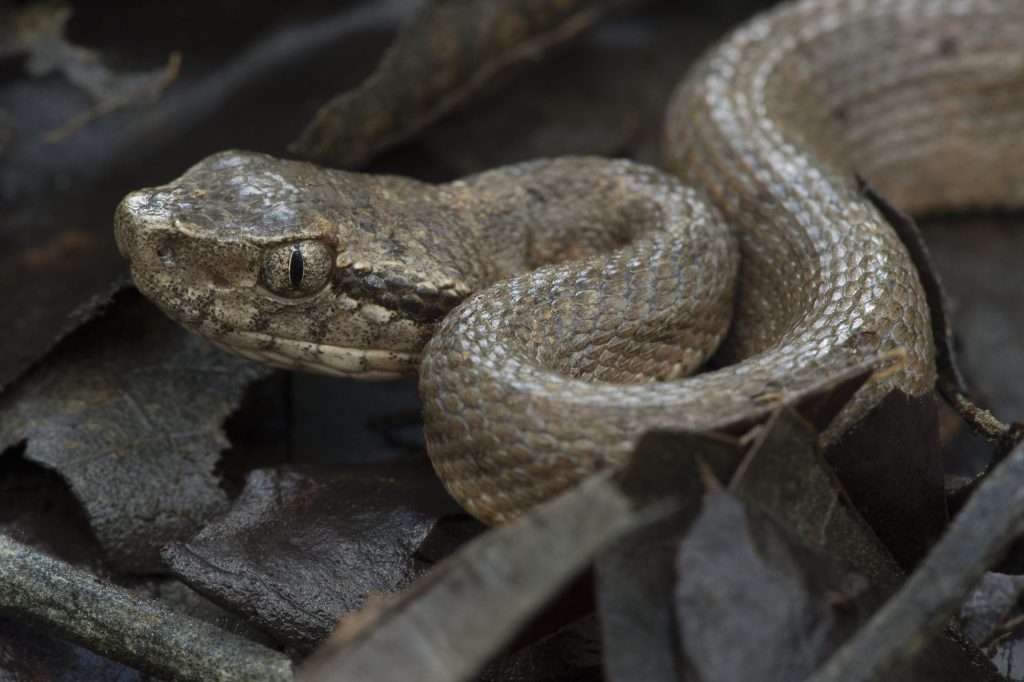
An increase in sightings of the fer-de-lance snake, also known as the Saint Lucia pit viper, has raised concern among residents across Saint Lucia, particularly in rural communities, prompting a coordinated national response.
Agriculture Minister Lisa Jawahir, speaking alongside forestry officials on March 23, described the situation as troubling and underscored the need for clear public guidance.
“We are at a place that is very concerning for me as Minister with responsibility for forestry and that also includes wildlife,” she said. “Over the last few weeks and months, we have had an increase in sightings of the fer-de-lance, and we have seen various reactions from the general public.”
Jawahir stressed the importance of educating citizens on how to respond safely.
“At this point we know that it is very important to communicate to the people of Saint Lucia what we can do and what we cannot do,” she added.
Technical officers within the Division of Forestry say a key gap remains in understanding the population and distribution of the species on the island.
Assistant Chief Forestry Officer Piyus Haynes explained that a nationwide assessment is now being prioritized.
“There is a need to do a national population assessment of the fer-de-lance. We have never done this before. We do not know how many are out in the wild,” he said. “We will never get a perfect number, but at least we can get an estimate.”
Haynes added that mapping the species’ distribution is critical to improving public safety.
“We need to find the distribution and map them so that we can know where they are. Because by knowing where they are, it also lends for safety and precaution,” he said. “If you know that something is in a particular place, you will be more cautious. But if you do not know that it is there, then your guard will be down.”
He urged the public to prioritize avoidance when encountering the snake.
“Moving away from the fer-de-lance is your first option,” Haynes advised. “If you see one in the forest reserve, you just divert your steps and continue on a safer path.”
He noted that in many cases, the best course of action is to leave the animal undisturbed.
“If you find a fer-de-lance in a wooded area and it is of no immediate threat, then it is best that you just leave the animal alone,” he said.
However, he acknowledged that there are circumstances where stronger action may be justified.
“The fer-de-lance is a highly potent animal,” Haynes said. “If you find it in your home, on your steps, or in your yard where there are children, then it is a direct threat to life. In a case like this, you may end up neutralizing the species and that would be a justified killing.”
Minister Jawahir also addressed ongoing efforts to improve access to antivenom, noting that discussions are underway at the Cabinet level.
“In the past we have had to source our antivenoms from countries like Costa Rica,” she said. “We are certainly looking closer to home, and we will share more information when that process has been completed.”
She added that the Ministry of Health will play a central role in the national response.
“The Ministry of Health is an integral part of the task force that will be developed, and they will be sharing more information on how to manage this moving forward,” Jawahir said.
Meanwhile, Acting Chief Forestry Officer Dr Donatien Gustave moved to dispel rumors circulating online about a bounty being offered for the killing of the snakes.
“What you saw was a message without official authorization,” he said. “Whilst it had the Coat of Arms, it did not have the Ministry of Agriculture, and it did not follow the proper process of approval.”
Gustave firmly rejected the claims.
“There is no information that is accurate, and we categorically condemn that message,” he stated.
Authorities continue to urge residents to remain vigilant, avoid unnecessary interaction with wildlife, and report sightings to the relevant agencies as efforts intensify to safeguard both human life and the island’s ecological balance.