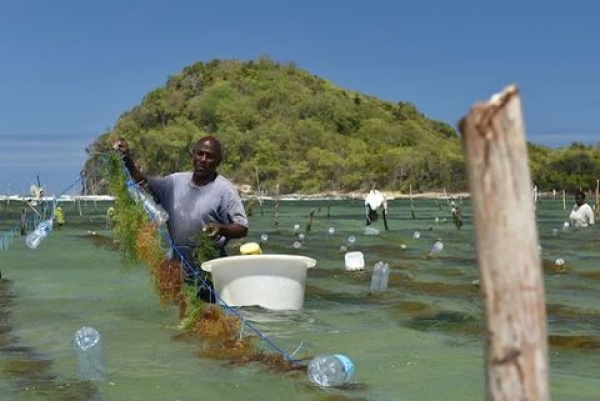
Women and young people in the community of Aupicon are gaining new economic opportunities through a grassroots training initiative aimed at transforming locally grown Seamoss into value-added products.
The programme, supported by the British High Commission, is equipping participants with the technical skills needed to produce professional-grade soaps using seamoss cultivated in the south of the island.
Political Officer at the British High Commission, Leandra Pinelle, said the initiative reflects the United Kingdom’s commitment to supporting sustainable livelihoods and community development.
“The British High Commission in Castries, on behalf of the UK Government, is pleased to be here today,” Pinelle said. “We are very excited that we have the opportunity to fund the Aupicon seamoss farmers to deliver this project.”
She noted that the programme places a strong emphasis on engaging women and youth in the growing seamoss industry.
“We believe the initiative is very important to engage the youth and women in seamoss farming,” she explained. “Seamoss farming has great potential in the south and we think that offering this support will be a stepping stone for farmers to go into agro-processing or to make their livelihood a bit more sustainable.”
Pinelle added that the High Commission is encouraged by the opportunity to contribute to the sector’s development.
“We are just happy to be able to support them,” she said.
Vice President of the Aupicon Seamoss Association, Brian Walker, said participation in the training has been strong, with turnout exceeding expectations.
“We have about 90 per cent of the attendance which we anticipated,” Walker said. “On the part of the British High Commission, it was a very good initiative where they gave us the association the funds directly.”
He explained that the project extends beyond training, incorporating additional components aimed at youth engagement and climate resilience.
“We know we have two other components of this project which would target the youth,” Walker said. “We also have a component which targets climate adaptation, where we are looking to build some rafts and deploy them.”
According to Walker, the planned rafts will improve working conditions for seamoss farmers.
“This would assist with a resting station, where when you are out there you can take a break and not be in the seawater the whole day, which is not good for your health,” he explained.
Consultant Yafalia Fulgence, who is facilitating the soap-making training, said participants are being introduced to practical techniques that allow them to diversify the use of seamoss.
“We are using the same base for soap making with oil and lye as per usual, and we are using seamoss as our base today,” Fulgence said.
She noted that trainees are being exposed to different methods of incorporating seamoss into the production process.
“They will be using both gel and powdered seamoss so that they can see the difference in the way that we make the soap,” she explained.
Fulgence added that the ultimate goal is to empower participants to create their own products and expand their economic prospects.
“We are hoping that after we give them the base, they can now create their own and make their own creations, so that they can use seamoss in several different ways,” she said.
The initiative is expected to strengthen the local seamoss industry while providing participants with practical skills to generate income through value-added production.