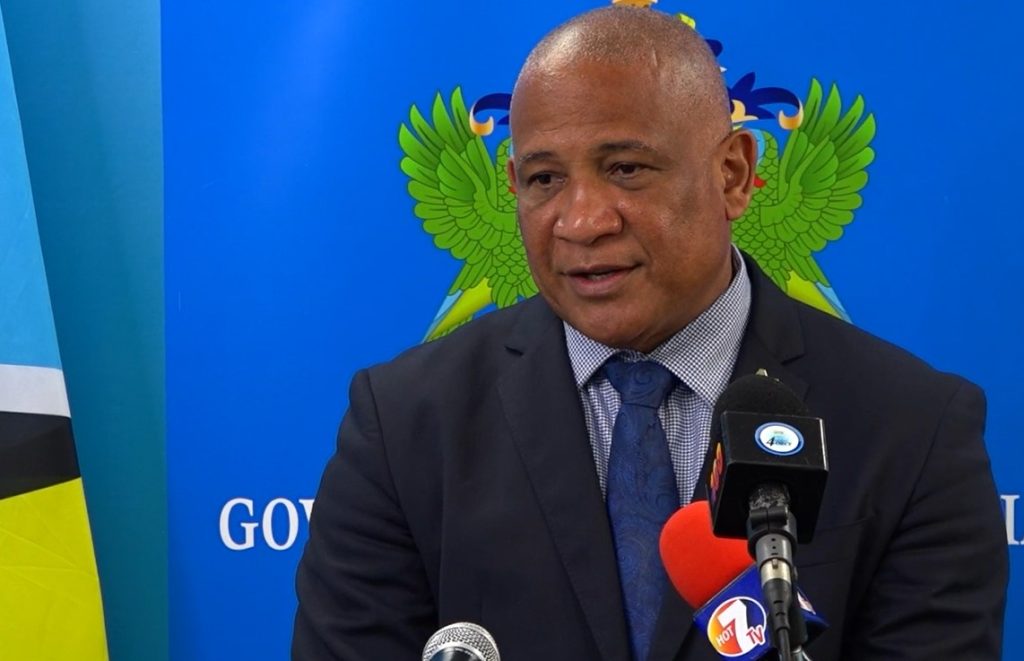
Minister responsible for Investment and the Citizenship by Investment Programme, Dr Ernest Hilaire, has defended the integrity of Saint Lucia’s Citizenship by Investment Programme while addressing the United Kingdom’s recent decision to impose visa requirements on Saint Lucian nationals.
Speaking during the sitting of the House of Assembly on Tuesday, March 10, 2026, Dr Hilaire acknowledged that some members of the public have attempted to link the visa restrictions to the country’s Citizenship by Investment Programme but insisted that no evidence has been presented to support that claim.
“Mr Speaker, I can understand why some would believe that the two are linked. That it is the CIP that is causing the increase in asylum seekers and illegal workers,” Hilaire said.
“Some would genuinely establish that cause was linked and others would, out of political malice, accentuate the words of the Home Office to serve their political purpose.”
However, the minister stressed that it would be inaccurate to conclude that the programme was responsible for the United Kingdom’s decision.
“It is wrong to leave the impression that Saint Lucia’s CIP is responsible for this problem when to date the data needed to establish that claim has not been shared with us,” he told Parliament.
Hilaire revealed that during discussions with international partners, Saint Lucia had repeatedly requested evidence that could help authorities address any potential misuse of the programme.
“Ever since discussions began with our international partners, Saint Lucia has been consistent. We have asked repeatedly for the relevant information on any concern with the CIP,” he said. “We have said if there are CIP citizens using Saint Lucia passports to claim asylum or to work illegally in the United Kingdom then share the data with us.”
According to the minister, that information has not been provided.
“We have been told repeatedly that such data cannot be shared and so the obvious question remains. How is any government expected to respond effectively to any abuse if the evidence is not available to address it?” Hilaire asked.
He reiterated that the government has been given assurances that the programme itself is not responsible for the UK’s action.
“I want to make the point. There is no evidence to suggest that our CIP is responsible for any increase in persons seeking asylum or working illegally in the United Kingdom. There is no such evidence.”
Hilaire noted that the government has previously taken action when concerns were raised about applicants linked to activities in other jurisdictions.
“When we became aware that action taken elsewhere in the region against certain applicants may have been linked to part of that problem, we moved immediately and barred applications from these nationals,” he said. “That is what responsible government looks like. It does not grandstand on social media or talk shows. It does not gossip. It does not speculate. It acts.”
The minister also emphasised that Saint Lucia will continue to collaborate with international partners to strengthen the programme’s oversight and safeguards.
“We will continue to work with all international partners to strengthen our programme and ensure that it is not a threat to anyone and remains a benefit to us,” he said.
At the same time, Hilaire noted that the introduction of a visa requirement ultimately places entry decisions in the hands of British authorities.
“With a visa regime in place, the decision to allow any Saint Lucia passport holder into the United Kingdom rests solely with the authorities in the United Kingdom,” he explained.
He also questioned the logic behind claims that the Citizenship by Investment Programme was the primary issue.
Turning directly to the role of the programme in national development, the minister argued that the Citizenship by Investment Programme has become an important economic tool for the country.
“Let us be honest, CIP is not some political gimmick. It is not a vanity project. It is not and has never been an end in itself,” he said. “It is a developmental tool.”
According to Hilaire, the programme helps provide financing for projects that might otherwise be difficult for a small island state to fund.
“It is one of the means by which a small island developing state like ours can fund roads, hospitals, schools, water security, jobs, climate resilience and wider national development in an era when traditional sources of development finance are shrinking and global pressures are growing.”
He argued that international funding options for infrastructure and development have become increasingly limited.
“No country is providing the grants we need. No country is providing the concessionary loans that we need. No country is building the infrastructure that we need in this country of ours,” Hilaire said.
“The roads, the bridges, the water supply, the fields, the community centres, the grants for small businesses, for youth projects, for creative industries, for housing. No one is providing that to us.”
For that reason, he warned against attempts to undermine public confidence in the programme.