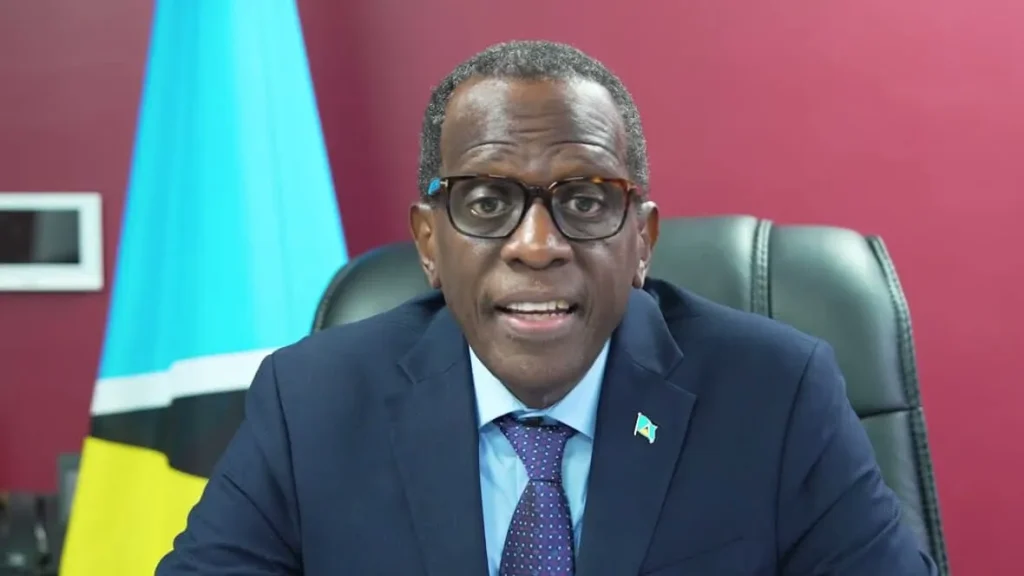
Prime Minister Philip J. Pierre has revealed that Saint Lucian students can no longer pursue medical studies in Cuba, describing the development as a major blow to the country’s healthcare system and a direct result of United States government dictates.
Speaking at the Second World Congress on Racial and Ethnic Health Disparities, Prime Minister Pierre said the decision has created what he described as “a major problem” for Saint Lucia, given the long-standing reliance on Cuban-trained doctors within the health sector.
“But we have a big problem. Many of our doctors got trained in Cuba, and now the great United States has said we can’t do that any longer. So, this is a major problem that I have to face. Most of our doctors, most of them, all right, two of our best doctors here are trained in Cuba.”
The Prime Minister explained that the issue extends beyond training, noting that restrictions also affect Cuban medical professionals who work in Saint Lucia.
“They are also Cubans who come over to work. So, the American government has said that we cannot even train them in Cuba. So, I have a major issue, a major issue,” he added.
Pierre placed the situation within the wider context of the difficulties faced by small island developing states, arguing that international pressures often have severe local consequences.
“To manage a small country of 186,000 people like Saint Lucia is a task that many will never understand. Apart from the fact that we have to deal with these international issues, which have nothing to do with us. We have never caused any war anywhere,” he said.
The Prime Minister also highlighted financial constraints within the health sector, pointing to the commissioning of the new St Jude Hospital as a clear example.
“It will cost us about 50 million US dollars to properly get our hospital furnished and ready to go. My budget cannot do it now,” Pierre stated.
He said efforts to generate additional revenue through the Citizenship by Investment Programme have also faced international resistance.
“I try to have a Citizenship by Investment programme, and I get blocked there also. I’m told that these people are terrorists, that they will cause money laundering, et cetera,” he said, adding that such pressures require careful navigation.
Beyond international politics and financing, Pierre addressed the social factors contributing to health disparities in Saint Lucia, including crime and violence.
“Severe disparities are caused by crime and violence,” he said. “When our young men get shot in gang warfare, they go to the hospitals. It costs hundreds of thousands of dollars to deal with these gunshots.”
He stressed that the consequences extend far beyond the immediate victims.
“Then they are crippled. You have to take care of them. You have social welfare to take care of them. So as much as we may think that they are just killing themselves, it impacts on us indirectly,” Pierre noted.
The Prime Minister also pointed to reckless driving and unhealthy lifestyles as contributors to rising healthcare costs and long-term disparities.
“When people drive recklessly on the road and they get injured, apart from the hospital costs, they are crippled. It is a cost on us,” he said, adding that lifestyle-related illnesses among young men are placing additional strain on the system.
Pierre urged a more practical and people-centered approach to addressing these challenges.
“We have to find a way to translate our knowledge and translate our intellect to make it real and practical for the people of these countries,” he said.
The Second World Congress on Racial and Ethnic Health Disparities is being hosted in Saint Lucia from January 27 to January 31, 2026. The hybrid event brings together international and regional professionals to discuss racial and ethnic health disparities and strategies to overcome them, with a focus on research, policy, and community-based solutions.