

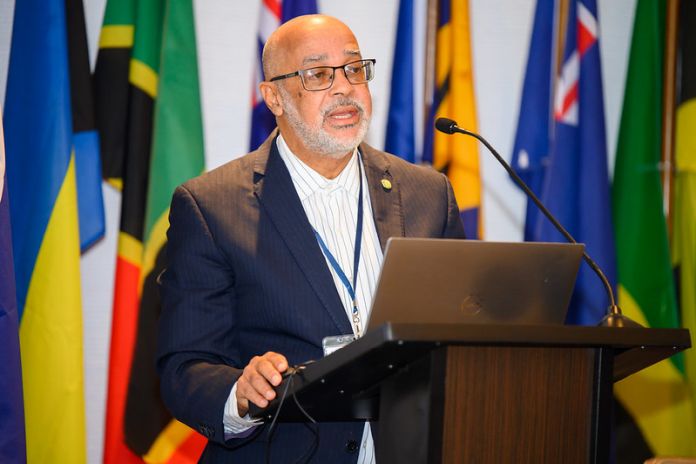
History was made across the Organisation of Eastern Caribbean States today as every student from kindergarten to secondary school took part in a single, region-wide census designed to capture what education leaders describe as the most important missing element in policy making: the authentic voice of the learner.
OECS Director General Dr. Didacus Jules said the initiative is unprecedented in scope and purpose.
“For the first time anywhere in the world, every student from kindergarten to secondary will take part in a single region wide student census. Not a sample, not a survey of a few, a true census giving every child the chance to be heard,” he stated.
Dr. Jules added that the exercise carries deep significance for the future of the region. “Why does this matter? It matters because education is at the heart of our region’s dream that every child, no matter where they live, deserves an equal chance to learn and succeed.”
Dr. Jules explained that for decades education data in the Caribbean has focused heavily on exam results, budgets and school performance indicators, but has not captured the lived experiences of students.
“We have data on exams and budgets, but what we have never had is the voice of the learner. How students actually experience school. How safe they feel. Whether you enjoy learning. What challenges you. And what would you change if you could,” he said. According to him, the OECS is “the first region in the world to undertake this total student voice census” because “transformation begins with listening and listening intently.”
The census is tailored to students across different age groups.
Dr. Jules explained that “every child will be asked questions suited to their age. The youngest will respond through pictures and smiley faces. Older students will answer short questions about teaching subjects and their future plans and aspirations.” He emphasized that privacy is guaranteed. “No names will be taken. Every answer is confidential.”
The Director General said the results will directly shape national education priorities and investments. He offered several practical examples of how governments will use the new data.
“If children in one district feel unsafe walking to school, the data will guide investments in lighting, transportation, and supervision,” he said. “If most students identify mathematics and science as hardness, we can target teacher training and resource support where it is most needed. If many complain about bathrooms or heating classrooms, governments can prioritise maintenance and hopefully solar powered air conditioning upgrades. If older students feel unprepared for careers, ministries can expand TVET programmes and career guided services.”
Dr. Jules stressed that the purpose of the census is to turn student perspectives into concrete action. “This is how data becomes transformation, where every student’s voice