

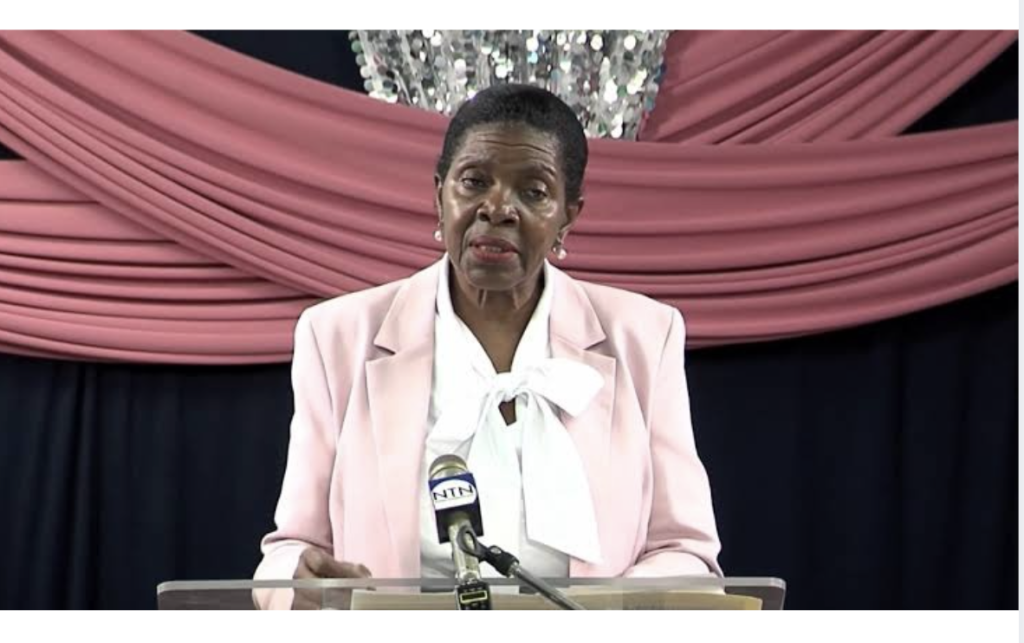
Social Justice Minister Emma Hippolyte is calling for a coordinated national response to crime and violence, urging government agencies, the private sector, community organizations and other stakeholders to work together rather than duplicate efforts.
Hippolyte said the country continues to face complex challenges associated with crime, including situations in which young people from the same families find themselves on opposing sides of violent conflicts.
“In my own constituency of Soufriere-Fond St Jacques, I have to be dealing with young persons who are related, blood relatives, and who are on opposite sides,” she said.
The Minister said the response must extend beyond law enforcement and involve institutions and individuals already working with vulnerable young people.
“As a government, we need to embrace a lot of work that is being done by other members of the society,” Hippolyte said, pointing to individuals including Dr King and Priest Kailash who are involved in community-based initiatives.
“We really need to bring everybody together and see that we do not duplicate the efforts, but we must work with one vision,” she added.
Hippolyte identified education, youth development and the private sector as key partners in the national effort, particularly through mentorship and apprenticeship opportunities.
“Significant work must be done within the Ministry of Education, within the Ministry of Youth and Sports, and the private sector as well, especially in terms of mentorship and work-apprentice programs,” she said.
She also called for greater attention to individuals who influence young men to become involved in crime.
“And we need to deal as well with some of the persons who are encouraging our young men to be in these issues. So we need to be able to sit around the table and say how we deal with it,” Hippolyte said.
The Minister also raised concerns about young offenders being housed at the Bordelais Correctional Facility, arguing that the environment is not suitable for rehabilitation.
“We have to see what provision we make to remove our juvenile offenders out of the Bordelais Correctional Facility,” she said.
Hippolyte said her visits to the facility had reinforced her concerns about the presence of minors there.
“Because when I go there and I see we have young persons below the age of 18 there, and they have committed hard crimes, but I see they’re in the wrong university,” she said.
“If we have to transform them, then that’s not a place for them,” she added.
The Government, she said, is therefore examining options to improve facilities dedicated to juvenile rehabilitation and training.
Hippolyte said work was being considered on the George Charles School as part of plans to relocate the Boys Training Centre from its current location in Rosalie.
“As a government, we are looking at seeing how best we can renovate the George Charles school, how we can quickly renovate it to move the boys training center from Rosalie to there,” she said.
She also outlined the possibility of renovating the existing Boys Training Centre to accommodate juvenile offenders currently housed at Bordelais.
“And as a medium to measure, how do we renovate and fix up the boys training center so that the juvenile persons in the Boys Training Centre, in Bordelais, should move to there,” Hippolyte said.
The Minister’s comments came alongside a tribute to Commissioner Bernard, whom she described as “a man of integrity, courage and unwavering commitment to public service”.
“His leadership was grounded not only in the pursuit of justice, but also in the belief that strong communities are built through compassion, partnership and opportunity,” she said.
Hippolyte’s remarks underscored her call for crime prevention to be treated as a shared national responsibility, with greater coordination between government institutions, communities and organizations already working with young people.