

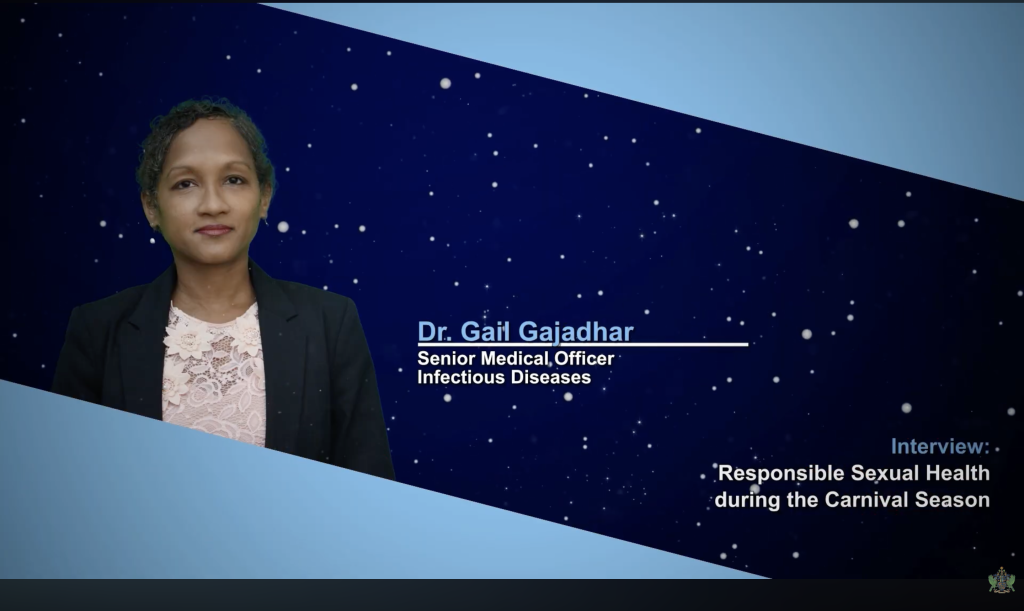
As Carnival celebrations gather momentum across Saint Lucia, the Ministry of Health, Wellness and Nutrition is encouraging revelers to make responsible decisions by prioritizing their sexual health and protecting themselves against sexually transmitted infections (STIs).
Senior Medical Officer for Infectious Diseases, Dr Gail Gajadhar, in a statement made on July 3, urged people to prepare ahead of time and take practical steps to reduce their risk, particularly if they expect to consume alcohol or other substances during festivities.
“So if we’re talking about sex and sexual health, I would like to remind persons to first of all be proactive and carry your condoms with you,” Dr Gajadhar said.
She noted that impaired judgement during celebrations can increase the likelihood of risky behaviour.
“If you find yourself in a situation and you are under the influence of substances and you know you are likely to do stuff that you wouldn’t normally do, for example you know a sudden sexual encounter, you want to ensure that you have some form of protection to do so,” she explained.
Dr Gajadhar also encouraged individuals to take responsibility for their own protection rather than relying on a partner.
“You wouldn’t like yourself to be in a situation where your partner says I don’t have a condom, hey you can show them the condom so that issue about a condom is not there,” she said.
In addition to condom use, she highlighted the availability of Pre-Exposure Prophylaxis, commonly known as PrEP, as an effective HIV prevention tool.
“But I also want to take the opportunity to tell persons that we have something called pre-exposure prophylaxis, the shortened form of it is called PrEP and PrEP is one pill a day, can help keep HIV away,” she said.
However, she cautioned that PrEP does not provide protection against other sexually transmitted infections.
“It will not protect you from other sexually transmitted infections like gonorrhea, chlamydia, syphilis etc. but it is one step to reducing your risk of getting HIV from unprotected sex.”
Dr Gajadhar stressed that sexual health should be regarded as an essential part of overall wellbeing, just like heart health, nutrition or mental health.
“We hear about good oral health, we hear about practicing good nutrition, we hear about heart health, skin health, eye health, you know, your mental health as well. So sexual health is an important part of your health,” she said.
She encouraged sexually active individuals to make regular testing part of their healthcare routine.
“If you think there’s something wrong, you become anxious, you want to get tested, you want to know what’s going on,” she said. “So I want everybody to first of all ask yourself this question, when was the last time I got tested for a sexually transmitted infection? I am sexually active, when was the last time I got tested for a sexually transmitted infection?”
According to Dr Gajadhar, testing for infections such as HIV and syphilis is quick and readily available.
“Things like HIV and syphilis, you can get tested for very quickly, 15 minutes you can get your results,” she noted.
She also encouraged people to reflect honestly on their sexual practices.
“I want you to think, do I practice safe sex, like do I use condoms? Who do I use condoms with? Do I have more than one partner? Do I decide which partners I use condoms with and why?”
While reiterating the importance of PrEP in preventing HIV infection, Dr Gajadhar stressed that condoms remain the best defense against a wider range of sexually transmitted infections.
“Barrier contraception, that is a good way to protect yourself from infections,” she said. “I mentioned PrEP earlier to help protect yourself against HIV, but you still need the condoms to protect you from all the other things, the syphilis, the hepatitis B, the chlamydia, the gonorrhea, whatever else is out there.”
For those entering long-term relationships, she advised couples to undergo STI screening together and openly discuss their results.
“If you are engaging in a long-term relationship and you want to, you know, continue on with that person, I would suggest as partners, you both get tested, yeah, you get tested for HIV, syphilis, etc. and share your results, be open so everybody knows what page you’re starting on,” Dr Gajadhar said.