

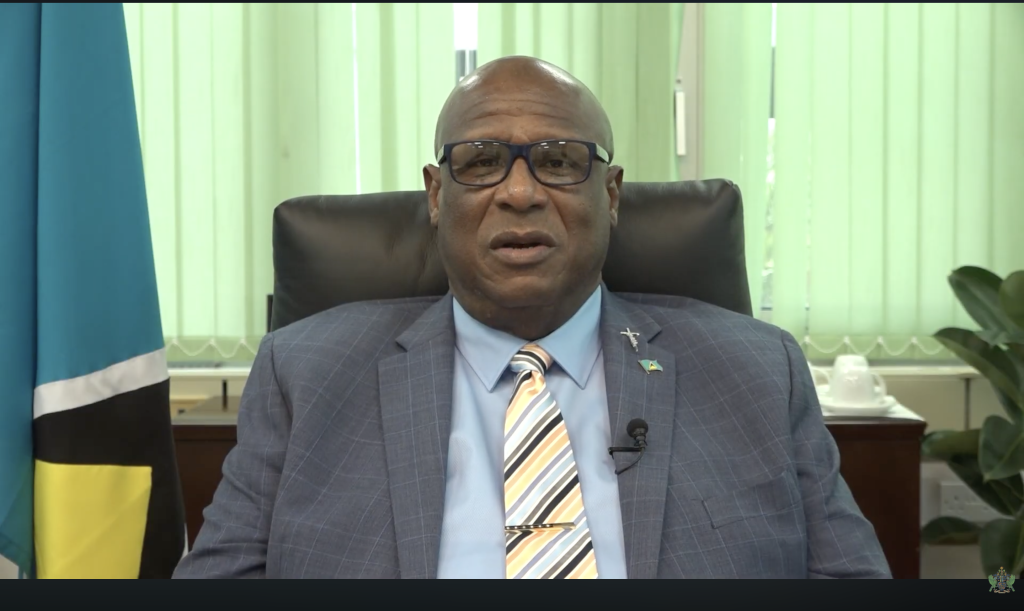
Senior Minister and Minister for the Public Service, Stephenson King, has defended the government’s decision to seek financing for preparatory work on the redevelopment of the Sir Julian R. Hunte Highway, arguing that the project is long overdue and accusing the former United Workers Party administration of stalling a critical national infrastructure initiative.
King made the remarks during debate on a parliamentary resolution authorizing the Minister for Finance to borrow US$833,500 from the Caribbean Development Bank (CDB) to finance consultancy services for a feasibility study and detailed designs to upgrade the Sir Julian R. Hunte Highway and selected secondary roads.
The proposed project is intended to improve road safety, efficiency, climate resilience and accessibility along one of Saint Lucia’s busiest transport corridors.
Speaking in support of the resolution, King said the loan represented more than a financing arrangement. He described it as an opportunity to resume a long-term vision that had been interrupted.
“Mr. Speaker, I am very proud to stand this afternoon in support of this resolution which grants the Prime Minister, the Minister for Finance, to obtain this loan of 833,500 U.S. dollars from the CDB for the Sir Julian R. Hunt Highway,” King told Parliament. “The reason I say this, Mr. Speaker, is that there is a benefit in continuity, a benefit in continuity of maintaining the trajectory that a particular government has developed to ensure that projects are delivered to the people of this country.”
Drawing on his own experience as a former Minister for Infrastructure, King said he had urged the previous administration, following the 2016 general election, to continue several major infrastructure projects that were already in progress.
“In a number of cases, I was told that that’s not necessary. We don’t want to increase the debt-to-GDP ratio,” he said. “The Castries-Gros Islet Highway, now the Sir Julian R. Hunt Highway, was one of those projects which I thought at the time was absolutely necessary.”
King said the original vision, developed when Prime Minister Philip J. Pierre served as Minister for Infrastructure, was to transform the Castries to Gros Islet corridor into a modern four-lane highway while upgrading key secondary roads to improve traffic flow across northern Saint Lucia.
“When I joined the ministry, there were ideas, there were plans, there was a vision,” he said. “The intention then of the administration, under the astute stewardship of the Honourable Philip J. Pierre, who was Minister for Infrastructure, was a vision of improving the Castries-Gros Islet Highway, four-lane highway.”
He noted that elements of the vision had already been realized through the construction of the Bois D’Orange and Bonté bridges as four-lane structures, while plans also included improvements to roads such as Vieux Sucrieux to Norbert, Corinth and Assou Canal to create an interconnected road network.
According to King, the former administration rejected the proposal because of concerns over public debt.
“But the then government advised there was no need for it, because it would increase our debt-to-GDP ratio,” he said.
King argued that the current government’s completion of the Monchy, Corinth, Vieux Sucrieux, Norbert connecting road has already demonstrated the benefits of the broader transport strategy.
“What we have seen over the years, Mr. Speaker, is that while many people have said that we need to do something about the number of vehicles entering the country, we’ve also seen that that plan which was already in place has produced some results,” he said.
He described the new roadway as an important investment in public safety and traffic management.
“A road that has gone into the hinterland, improving the carriageway, improving the safety on that road, and making many people a lot safer, a lot more comfortable and secured when driving.”
King added that motorists are already experiencing reduced congestion on the Sir Julian R. Hunte Highway because of the alternative route.
“Because of that, we can see a relaxation of the volume of traffic on the actual Julian Island Highway, meaning that when you traverse that road, you can feel the traffic, even when there’s traffic, you can feel the traffic is moving.”
He said this demonstrated why the current borrowing request is essential to move the next phase of the project forward.
“That’s the reason why I believe this loan is critical,” King said. “Though it is coming ten years later, if only a government had continued, or if only the government who came into office had seen the wisdom in the plan, the wisdom in that vision plan, and had continued, today we wouldn’t have been here seeking that loan for the reconstruction of the highway to do the necessary feasibility studies.”