

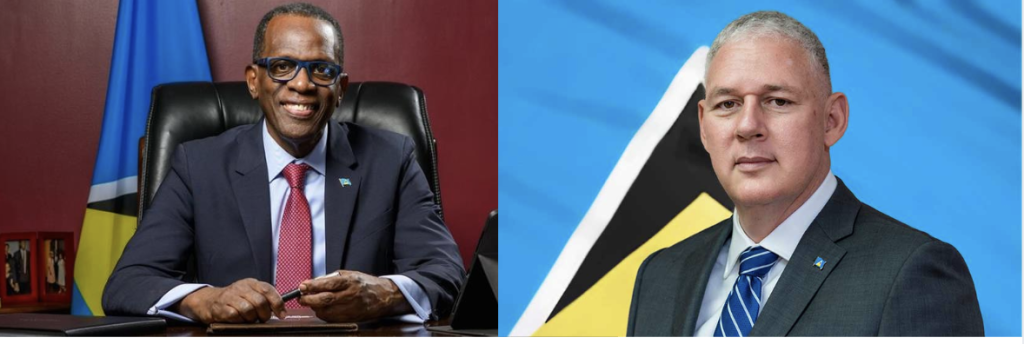
Prime Minister Philip J Pierre has sharply criticized the way financial institutions treat politically exposed persons (PEPs), describing banking practices as “ridiculous” and “disrespectful” during a sitting of the House of Parliament on June 23.
“The banks are ridiculous. They are ridiculous, Mr. Speaker. They’re ridiculous, and I’m saying it without any fear or favor, in the way they treat us, PEPs,” Pierre told Parliament. “The way they treat politically exposed persons, Mr. Speaker, it is ridiculous. Sometimes it’s disrespectful.”
He argued that compliance requirements imposed by banks are excessive, even in routine transactions involving public officials.
“Mr. Speaker, the government paid us our gratuity. You know, Mr. Speaker, when you deposit the gratuity cheque, the bank asks you for a source of funds; a cheque from the Treasury, they ask you for a source of funds from the Treasury.”
He described the experience as undermining the dignity of public service.
“This is absolutely ridiculous. It’s disrespectful and it almost makes you believe that public service is an offence,” Pierre said. “Almost makes you believe that public service is an offence.”
The Prime Minister also raised concerns about what he described as excessive scrutiny placed on ordinary citizens engaging in small financial transactions.
“Secondly, Mr. Speaker, a baby had a christening party. Some people gave gifts of cash. The mother wants to deposit that money in the bank,” he said. “The bank asked for a letter saying who the baby’s mother is. Then they asked for a letter saying who gave the cash. Then they asked for a letter saying who will put more cash in the accounts for the baby.”
He added that such requirements were unreasonable for low-value deposits.
The Prime Minister called on the Eastern Caribbean Central Bank to intervene in what he described as unacceptable compliance behaviour by financial institutions.
“We call on the Central Bank, although the Central Bank professes not to control these things, to speak about the compliance officers in these banks, to stop disrespecting people, Mr. Speaker. This is disrespect.”
Opposition Leader Allen Chastanet, while acknowledging the concerns raised, shifted the focus toward broader governance and accountability issues affecting financial trust and international banking relationships.
“It certainly was not part of the presentation and the motions that we saw, but the Prime Minister brought up this issue about PEPs,” Chastanet said. “And I want to say to the Prime Minister, I too go through my situations with PEPs, full of examples, how long it’s taken my kids to open up a bank account over three years.”
He said the solution lies not only in banking practices but in strengthening state institutions.
“But the solution to that problem, Mr. Speaker, is greater transparency,” Chastanet said. “We have an integrity commission that does not function. We have boards that are not producing their audited reports. We have no example of where there’s been misappropriation that anybody has been held accountable for anything.”
Chastanet warned that weaknesses in governance systems could affect correspondent banking relationships, which are essential for international financial transactions.
“And for my constituents, a correspondent bank is a very important entity. It’s the international entity that allows a bank here to interact internationally,” he explained. “If you want to transfer monies to families and friends, or families and friends want to transfer money to you, they cannot do it without a correspondent bank.”
He noted that global regulatory pressures, particularly from the United States, are increasing scrutiny on financial flows.
“And the laws in America are holding the correspondent banks extremely accountable for AML, anti-money laundering issues,” he said.
Chastanet added that the sensitivity surrounding PEPs stems from their access to decision-making power, though he stressed he was not making any allegations of wrongdoing.
“When monies are transferred from a contractor who is getting contracts from the government, when they are senior civil servants, and they are politicians who are in a position to influence monies to go one way or the other, not making any incrimination against anyone,” he said. “It’s that power and that discretion at the end of the day that is the cause of PEPs.”