

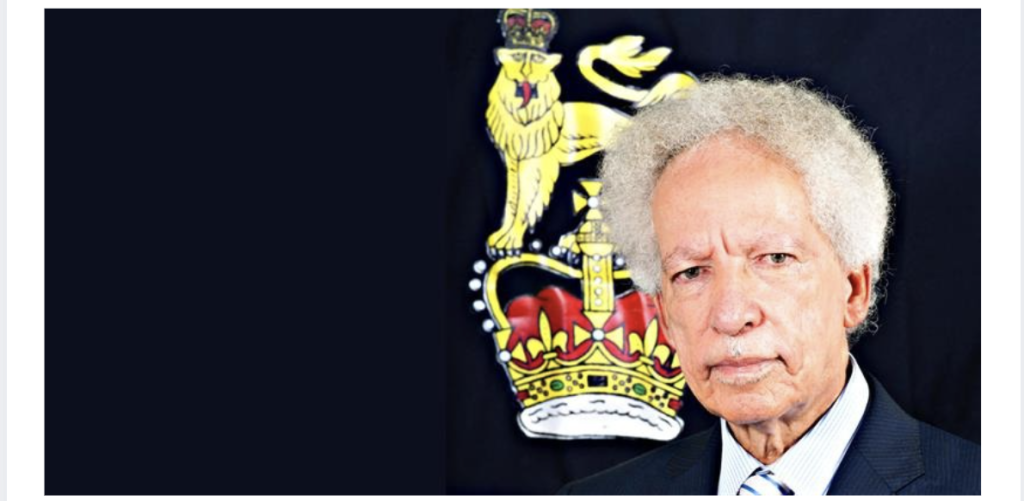
The life and legacy of former Governor-General Sir Emmanuel Neville Cenac were honored with solemn dignity and deep emotion on Thursday, June 18th as Saint Lucians gathered to pay their final respects to a statesman remembered for his public service, political conviction, and enduring love for country and family.
The funeral service, held on June 19, brought together national leaders, dignitaries, and members of the public in a tribute reflecting Sir Neville’s long and complex contribution to national life. Family members delivered deeply personal reflections that painted a portrait of a man defined not only by public office, but also by faith, music, political passion, and personal sacrifice.
His son, Acting Solicitor General Seryozha Cenac, recalled his father’s spiritual grounding and offered a final reflection on what he believed Sir Neville would have wanted for the nation and its leaders.
“I recall two songs he would often sing at home, Jesus’ heart all burning and what could my Jesus do more,” he said.
In closing, he reflected on the presence of political leaders at the service and the symbolism of Sir Neville’s final farewell.
“In closing, I think our father would be happy to see you all here, particularly members of the Labour Party,” he said. “It is ironic indeed that it is the part of his heart that has given him this state funeral.”
Addressing national leaders directly, he added: “To you, Honourable Prime Minister, I am sure he would say, referencing the Labour Party which he loved, to all our leaders, present and future, I am sure he would say, make Saint Lucia the Gibraltar of the Caribbean. She is our most cherished and only possession.”
His daughter, Judge Cybelle Cenac, offered a deeply personal tribute that highlighted her father’s artistic spirit, his devotion to family, and the emotional complexity of his political journey. She recounted a love song he had written for her mother, which later gained international recognition.
“He once wrote a song for Mommy when she had left Saint Lucia at the tender age of just 16 for the United Kingdom,” she said. “It began, My dearest one, so far but near, I love no other one but thee. If you take my advice not to philander, the day will come when we too shall be one.”
She explained that the song travelled far beyond Saint Lucia and was later recorded.
“The song was sent to Nashville in the United States where it won some prize and was put to music and on an LP record,” she said, adding that her father “would sometimes sing the song to Mommy. She blushed every time.”
In a lighter reflection, she noted his playful personality. “I am told that he also sang it to his CPO and driver at Government House on an occasion or two. But really the song belonged to Ma. So much of him belonged to her.”
Judge Cenac also reflected on his deep political identity and enduring ideological ties.
“He loved Ma. He loved his children. He loved Laborie. He loved Saint Lucia. And he loved the Labour Party. Even after he found a home elsewhere,” she said. “Yes, he loved the UWP and those who received him. But he never ceased to be a man whose first political language had been Labour. Justice, the poor and the common good. He has been always, and at the last, Chè Labour.”
She spoke candidly about the emotional contradictions of political life and loyalty, noting that her father understood separation without erasing belonging.
“There is a kind of love that remains even after separation. It is not always understood by those who view life only through victory and defeat. But Daddy understood it,” she said. “He understood that one may leave a house and still remember that it was once home.”
She also addressed the public criticism her father endured throughout his life, describing the impact on the family while rejecting bitterness in favor of remembrance and grace.
“That is why I do not wish today to speak anger over anyone, that he suffered much from words spoken over him. We, his family, have suffered alongside him,” she said. “Every shouted ‘sousè, traitor, cross the floor,’ shouted across the street, towards a platform, have been hurtled in hate, and so thoughtlessly, against a man they did not really know.”
She said her father responded to such attacks with dignity and humor.
“But in true daddy fashion, he received it kindly, with grace and humor, because he knew the hearts of men, and what they believed he had deprived them of,” she said.
She concluded with a plea for a more compassionate national remembrance.
“But we repay none of that with bitterness, for to do that would be to have learned nothing of the man under whose wing we grew up. I ask instead, that we remember him more generously, more truthfully, and more completely.”
As Saint Lucia said farewell, the service stood not only as a moment of mourning, but also as a reflection on a life that moved between politics, public duty, artistry and family devotion, leaving behind a legacy now held in national memory.