

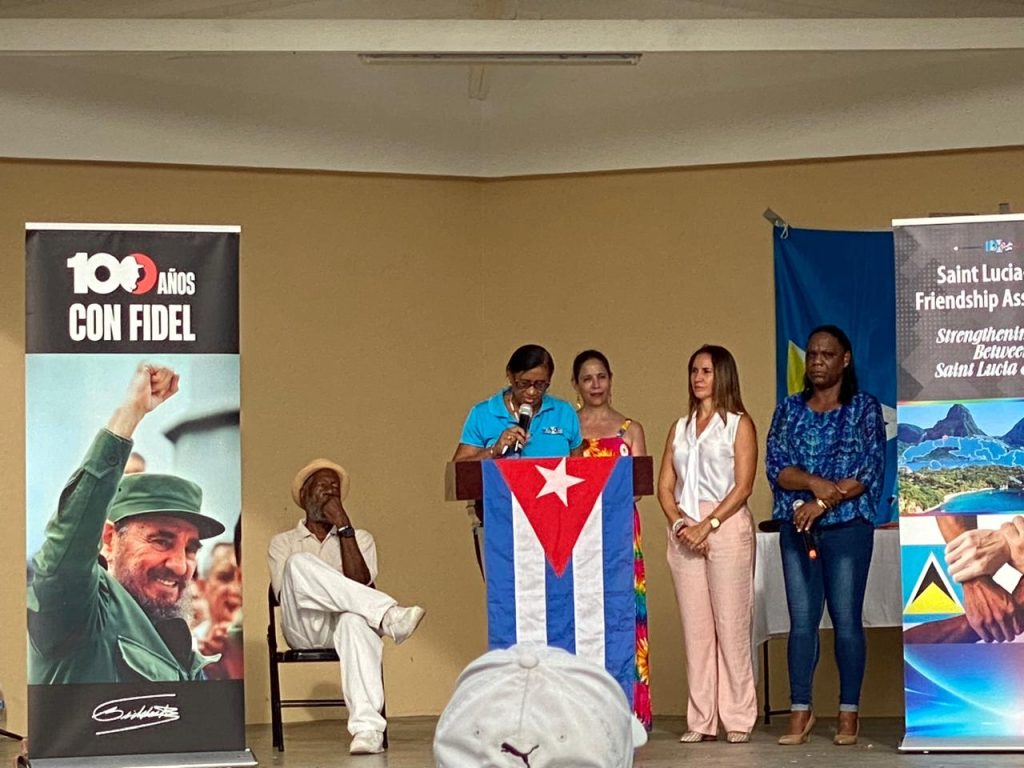
Members of the Saint Lucia-Cuba Friendship Association gathered at Serenity Park in Castries on Saturday, June 6, for a solidarity meeting aimed at raising awareness of the economic and social challenges currently facing Cuba and reaffirming support for the Cuban people.
The event provided an opportunity for the association to share experiences from a recent visit to Cuba and outline ongoing fundraising efforts intended to provide humanitarian assistance to communities affected by shortages and economic hardship.
President of the Saint Lucia-Cuba Friendship Association, Marleen Alexander, recounted her recent visit to Cuba, which formed part of a regional solidarity mission involving representatives from across the Caribbean, Latin America and Africa.
“During my visit, I was accompanied by a delegation from Barbados, from the Sixth Region Movement, mobilizing persons from the Caribbean region, Latin America to Africa,” Alexander said.
She explained that the delegation held discussions with several Cuban organizations and officials, including representatives of the Cuban Institute of Friendship with the Peoples.
“We had opportunities to hold discussions with representatives from the Institute of Friendship with the peoples, ICAP as it is well known for. We also had discussions with the president of the Cuban Caribbean Association of the Parliament.”
According to Alexander, one of the most significant aspects of the visit was the delivery of humanitarian supplies to the community of Baragua.
“One of the highlights of the visit was the presentation of the humanitarian items to the community of Baragua of solar lights, medicine, painkillers, toiletries, and personal hygiene, food items, and non-perishable goods from the visiting delegation,” she stated.
In addition to material assistance, the delegation also provided financial support.
“Financial donation amounting to over $5,000 U.S., approximately $13,000 EC dollars was presented to ICAP,” Alexander revealed.
She noted that a substantial portion of the funds was directed towards renewable energy initiatives.
“Most of the financial donations were presented to ICAP. In U.S. dollars, we’re looking at 3,700 U.S. A little over 10,000 assisted with the purchase of solar panels and balance of the financial donation was presented to the community of Baragua.”
Alexander said the visit provided first-hand insight into the difficulties currently confronting Cuban citizens.
“As many of you are aware, Cuba is currently facing significant economic and energy challenges. Shortages of fuel have affected transportation, electricity generation, food distribution, and many aspects of daily lives,” she said.
She added that recurring power outages have become a major burden for households and institutions.
“In several parts of the country, prolonged power shortages have become a regular occurrence, creating hardship for families, school children, hospitals, and business places to operate effectively.”
Reflecting on her observations while travelling through Havana and other parts of the country, Alexander described a noticeable change from previous visits.
“I experienced the emptiness whilst in Cuba of the streets in Havana and along the way when I was traveling to Barragua. All of the old-fashioned cars, the music, the crowded streets with the lively Cuban people, that was empty, that was missing when I went to Cuba this time.”
She said the usually vibrant atmosphere that many visitors associate with Cuba appeared subdued.
“Every time you pass in Cuba, you actually see people on the street, every corner you pass, you will see the music, people playing the music on the side of the streets. This time, when I step out, that was missing. The streets were empty, the malecon was empty.”
Despite the challenges, Alexander praised the resilience and adaptability of the Cuban people.
“I see many electrical motorbikes and other methods, cars, that the Cuban people, as usual, is making do. They adapting to the change very quickly.”
She noted that alternative forms of transportation have become increasingly common as residents adjust to fuel shortages and power constraints.
“So you will see a number of electrical cars on the streets in Cuba and a lot of electrical bikes. And as soon as, of course, they need electricity to charge, and as soon as electricity comes, it would charge whatever means of transportation they have.”
The Saint Lucia-Cuba Friendship Association says it will continue its solidarity efforts and fundraising initiatives as Cuba navigates ongoing economic and energy challenges.