

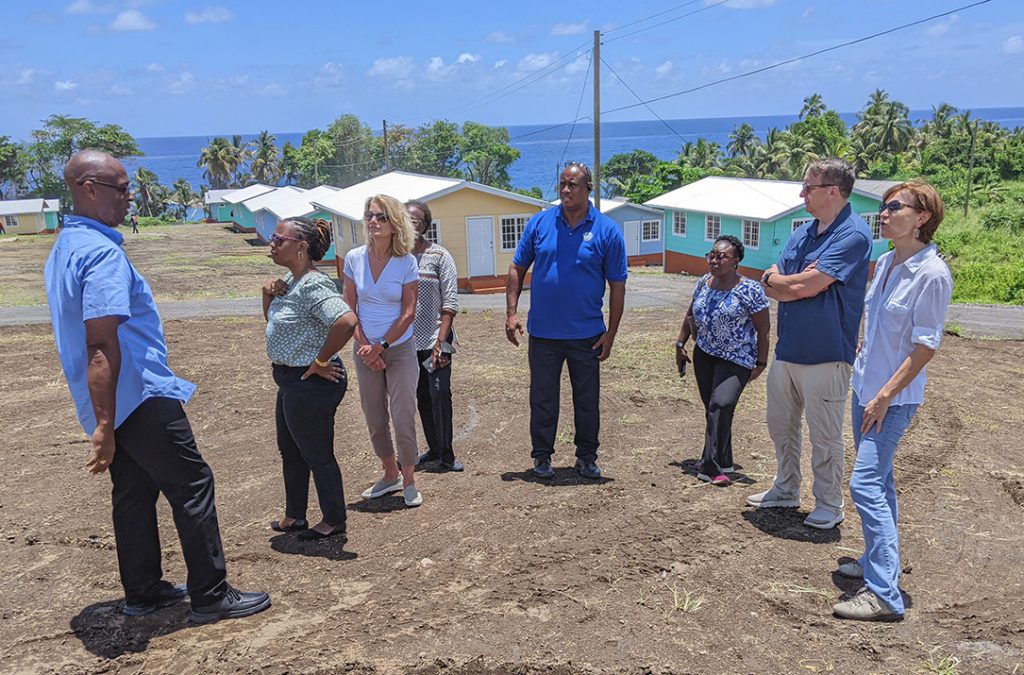
Saint Lucia is hosting a high-level Joint Country Performance Review aimed at evaluating the progress of 20 major national projects, with participation from the World Bank, the Caribbean Development Bank, government officials, and local project managers.
The five-day exercise, running from May 18 to May 22, focuses on initiatives linked to road reconstruction, transportation modernization, flood mitigation, and sustainable development. Regional examples, including Dominica’s geothermal energy programme, are also being examined as possible models for Saint Lucia’s future energy ambitions.
Permanent Secretary in the Ministry of Economic Development and the Youth Economy, Paul Hilaire, explained that national development projects are typically designed in response to identified challenges affecting critical sectors.
“A number of projects are informed by what are their problems,” Hilaire stated. “For instance, you have a case in point, WASCO. So one of the problems with WASCO may be that to deal with the distribution of water and water storage.”
He noted that once issues are identified, project teams begin preparing proposals aimed at resolving those concerns.
“So because of that problem where you’ve identified, then project briefs and documents are put together to develop what kind of interventions that can be put in place to try to resolve this process,” he explained. “So this is the genesis of how projects are conceptualized.”
Meanwhile, Operations Manager for the World Bank Caribbean Office, Gail Richardson, highlighted the importance of long-term planning and persistence when pursuing large-scale renewable energy projects such as geothermal development.
“The unique thing about the Dominica geothermal was it was actually a long time coming, a couple decades in fact, to get to where they are right now,” Richardson said.
She revealed that Saint Lucia is already receiving support in the early phases of geothermal exploration.
“What we’re doing with Saint Lucia is starting to support, we are supporting the drilling of exploratory wells and that’s what we’re focused on right now,” she explained. “Three, maybe two wells to see if we can make geothermal energy a reality for Saint Lucia.”
Richardson also addressed the financing mechanisms available to Caribbean governments through international lending institutions, noting that concessional financing remains one of the major advantages for small island developing states.
“We rely on the Ministry of Finance to make those decisions,” she stated. “The advantage of the resources that the World Bank makes available to Saint Lucia and other countries in the Caribbean, the small island states, is that the resources are very concessional.”
She added that governments often use such financing to accelerate critical projects that may otherwise take longer to implement using domestic funding alone.
“So the government wants to move forward on a number of projects, many of which they’ll finance on their own resources, some of which they may want to expedite, and therefore why not avail of financial resources that are a pretty good deal for them in terms of access to funds,” Richardson added.
Officials say the review process is expected to strengthen project implementation, identify challenges affecting delivery, and improve coordination among stakeholders involved in Saint Lucia’s development agenda.