

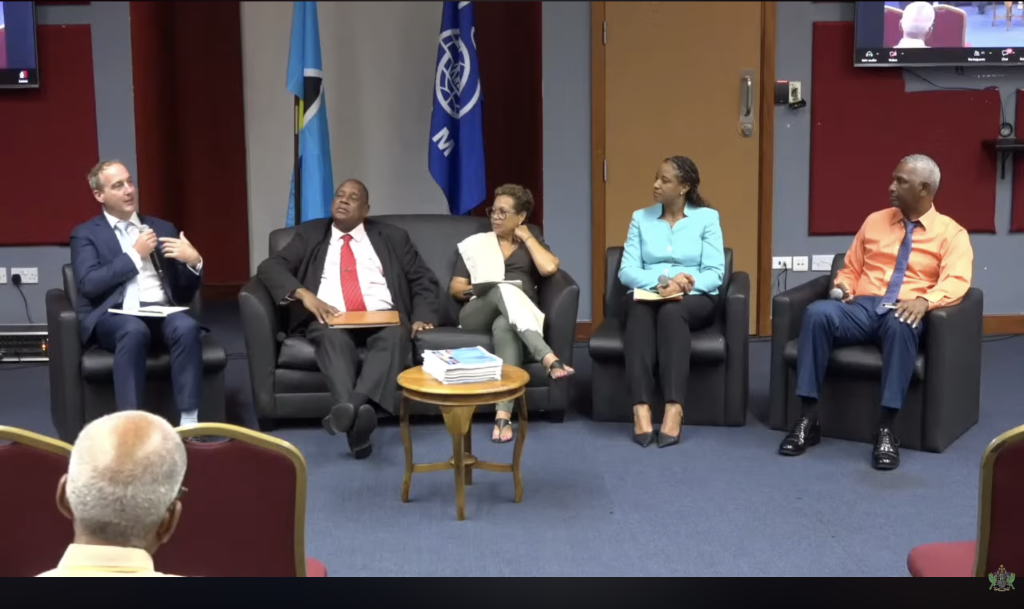
The government of Saint Lucia has taken a major step towards reshaping how the country manages migration, with officials unveiling a draft National Migration Policy on May 18, 2026, aimed at addressing demographic decline, labor shortages, border security, climate-related displacement, and diaspora engagement.
The initiative brings together government agencies, international organizations and civil society stakeholders in what officials describe as a comprehensive and development-oriented approach to migration management.
Coordinator for the Caribbean at the International Organization for Migration, Patrice Quesada, said Saint Lucia’s demographic realities make the policy particularly important at this time.
“In the case of Saint Lucia, what is very interesting is that right now, as you are probably very well aware, in terms of demographic, we are facing more or less slightly above zero percent population growth, which means that it’s currently reaching a plateau,” Quesada explained.
He warned, however, that deeper demographic issues are emerging beneath the surface.
“The reality is that fertility rates are already below 1.4. The replacement rate to ensure that there is a continuous growth of population is 2.1,” he said. “While the figure of growth is plateauing, the understanding is that the decline in terms of demographic will start.”
According to Quesada, the implications extend far beyond population figures.
“Demographic decline means aging population. It means investing in an industry of care. It also means that you would have less worker and more retirees, pensioners,” he stated. “From a fiscal perspective, it poses a lot of challenges.”
Quesada noted that the issue is not unique to Saint Lucia, stressing that many Caribbean nations are confronting similar realities.
“This is not just for the Caribbean. This is really across the Caribbean space,” he said. “How much this conversation that you have here can also inspire the rest of the Caribbean, and in particular CARICOM member states, but also member states of the OECS in the Eastern Caribbean.”
He argued that migration solutions must increasingly be approached from a regional perspective.
“A lot of solutions cannot just be national solutions. They will have to be regional solutions, by pulling resources together, by pulling ideas and solutions together,” Quesada said.
The IOM official also pointed to opportunities that migration could provide if properly managed.
“Remittances is one of them. Diaspora engagement and return is another one. Labour migration to fill gaps in sectors that are under tension is another one,” he explained. “There are plenty of solutions, but also challenges that need to be looked at from a social protection perspective and others, security perspective as we are mentioning.”
Meanwhile, His Excellency, Julian Dubois, Ambassador for Diaspora Affairs, outlined the policy’s central objective.
“The policy goal is to ensure migration in Saint Lucia is adequately measured, monitored, and managed through a gender-sensitive, rights-based, and development-oriented framework that promotes inclusion, protects vulnerable groups, and harnesses migration for national resilience and sustainable growth,” Ambassador Dubois stated.
He said the framework is grounded in several key principles, including “human rights and protection, gender equality and social inclusion, evidence-based policy, policy coherence and the whole-of-government approach.”
Dubois added that development remains central to the policy’s implementation.
“The hope is that at the end of implementing this policy, the focus is our national development goals,” he said, while also highlighting “alignment with regional and international frameworks, and public awareness and sensitization.”
Civil society representatives also used the opportunity to raise humanitarian concerns linked to migration policy reform.
Catherine Sealys, founder of Raise Your Voice Saint Lucia, pointed to Saint Lucia’s handling of migrants fleeing instability in Haiti.
“The humanitarian path of emigration,” Sealys said. “I noticed also that Saint Lucia is not a party to the 1955 UN Refugee Convention, neither the 1967 protocol.”
She expressed concern over the treatment of Haitian migrants entering the island.
“Over the last two weeks, it has been quite distressing that we are dealing Haitians for coming to Saint Lucia and running away from violence, we all know, all aware of,” Sealys stated.
She argued that legislative reform is urgently needed.
“We cannot amend the immigration act that we have. We need a new act because it doesn’t fit into this document that has been prepared and it doesn’t fit anywhere into any humanitarian thing,” she said.
Officials say consultations on the draft National Migration Policy are expected to continue as Saint Lucia works towards establishing a framework capable of balancing economic development, social protection, border management and humanitarian obligations.