

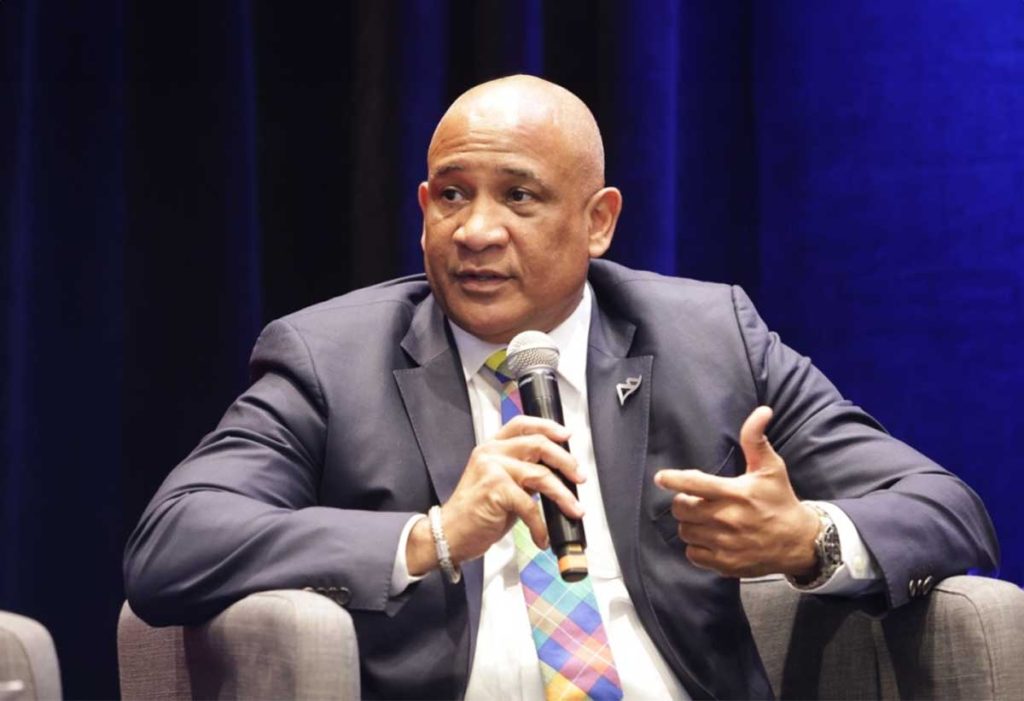
Tourism and Investment Minister Ernest Hilaire says Saint Lucia must continue positioning itself as an investment-friendly nation while creating greater opportunities for local entrepreneurs and small businesses to thrive in an increasingly competitive global economy.
Speaking during a May 11 press briefing, Hilaire said the island’s long-term economic success depends on its ability to remain adaptive, reduce bureaucratic barriers, and encourage both domestic and foreign investment.
“The solution must always be seen as a country of laws, as a country that respects investment and facilitates investment,” Hilaire stated. “Also to a country that really promotes the ease of doing business.”
According to the minister, investors are less likely to commit capital to countries where projects become stalled in lengthy approval processes and administrative delays.
“You want people who have capital to want to come to your country and spend, invest, and for them to not have to face so many bureaucratic hurdles and challenges, because there’s a cost to that,” he explained.
Hilaire warned that delays in obtaining approvals can discourage investment and drive investors elsewhere.
“When you want to get involved in investment, you don’t want to be delayed and your capital is tied up in processes,” he said. “You’d rather spend it somewhere else and get a Return on Investment, even if it’s a lower return, but at least you get something back on your capital, rather than it be locked up in Saint Lucia waiting for DCA approval, waiting for all those different processes.”
The minister said his administration has therefore placed considerable emphasis on improving the ease of doing business on the island.
“One of the first activities I did when I became Minister of Commerce is to get the department to organize the ease of doing business forum,” Hilaire revealed. “Let’s get an update on where we are and what’s the roadmap for moving forward.”
He disclosed that a report from the forum is expected to be released soon.
Beyond attracting foreign investment, Hilaire stressed the importance of developing what he described as Saint Lucia’s “indigenous capitalist class”.
“But more important for us as Saint Lucians is for us to be able to create a landscape where our indigenous capitalist class or business class can thrive,” he said.
Hilaire argued that economic prosperity depends on the production and export of goods and services, adding that Saint Lucia must continue identifying niche industries capable of competing internationally.
“For you to prosper, you must produce goods and services. That’s how you prosper,” he explained. “And more and more, you have to export it.”
The minister identified tourism as one of the island’s major export industries.
“Tourism is an export industry in many ways,” he said. “People come in, they use your services, and you earn out of it.”
Hilaire also pointed to emerging sectors such as sea moss, chocolate production, and condiments as areas with strong export potential.
“So some of the niche areas we have, the sea moss, the chocolate, the condiments, let us create those niche capacity areas, and for us to be able to export to the world,” he urged.
The minister said government support structures are intended to help ordinary citizens transform business ideas into sustainable enterprises capable of creating jobs and generating revenue.
“The average person must believe, if I have an idea, a feasible, viable idea, I want to translate it into a business that will create employment and earn revenue,” Hilaire said.
“But where do I go? And that is what those services we put in place will do,” he added.
Hilaire pointed to the government’s Youth Economy initiative as an example of how support systems can assist aspiring entrepreneurs.
“You have an idea as a young man, you can go to the youth economy, you can get the support, you can start your business,” he stated.
The minister acknowledged that not every business venture will succeed but argued that fostering entrepreneurship remains essential for national development.
“Fifty per cent of those businesses might fail, but if 50 per cent succeed, we’ve made progress,” Hilaire said.
He also cautioned against evaluating government programmes solely through immediate financial returns.
“You can’t look at all governing as dollars and cents, and whether you’re making profit,” he remarked.
According to Hilaire, the broader goal is to encourage Saint Lucians to believe in their ability to shape their own economic future.
“We have to say to our people, believe in our capacity to take charge of our prosperity,” he declared.