
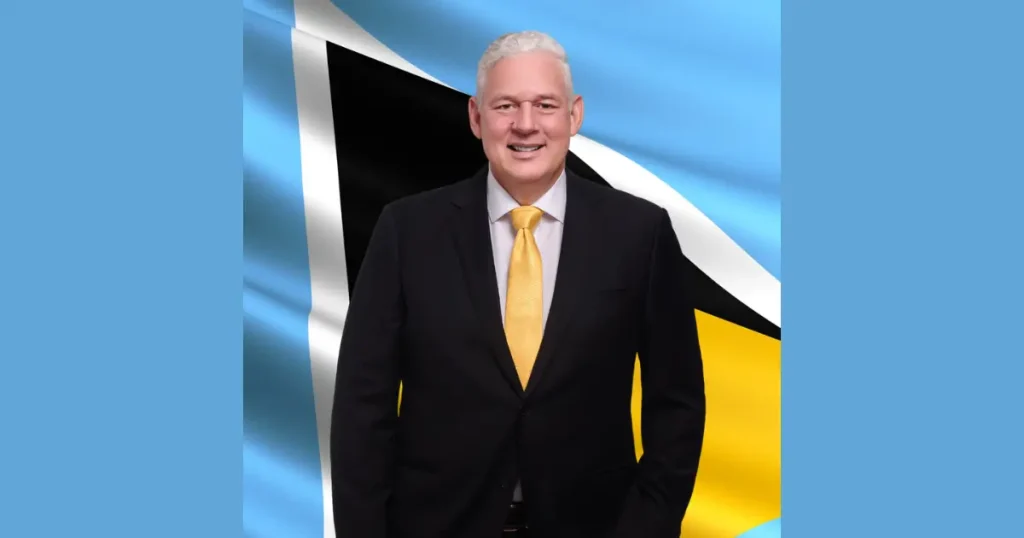
Opposition Leader Allen Chastanet has raised concerns about fiscal sustainability and the rising cost of living, as he delivered the Opposition’s response to the Appropriation Bill in Parliament on Friday, April 24, 2026.
Central to his contribution was a call for more targeted social support, arguing that existing programmes are too broad in scope.
“The idea that our social programs have to be substantially more targeted. We cannot continue to have social programs that are just blanket programs in which everyone benefits,” Chastanet said.
He added that the Opposition is prepared to support reforms in this area. “We, the opposition, will be happy to sit down with the government… because it is a difficult sell to people… but it is something that… ought to be done.”
Chastanet also voiced concern over proposed changes to how government performance is reported in the national estimates, warning that reduced transparency could undermine accountability.
“We are no longer going to be providing measurements of output,” he noted. “I think that that is a dangerous precedence… that is a step… in the wrong direction.” He stressed that performance indicators are critical to tracking how public funds are used. “At least we know what the money is going to, what the performance goals were, and… what the output goals… were achieved or not achieved. Very important in terms of accountability.”
Turning to the structure of public expenditure, the Opposition Leader highlighted the high proportion of recurrent spending across key ministries. “Ministry of Education, 93 per cent is recurrent. Health, 95 per cent… Home Affairs, 92 per cent… Tourism, 90 per cent, which is shocking,” he said, arguing that this limits the government’s flexibility to invest in growth.
He warned that the country may be approaching a point where expenditure growth outpaces revenue.
“If… revenue is growing slower than expenditures, or even worse… expenditures now are higher than revenue… it is very thin,” Chastanet cautioned.
Pointing to a reported surplus of $40 million, he argued that this figure is misleading when viewed alongside external financing. “We just saw a document to say that monies were taken from CIP to go into health… and into WASCO… almost $40 million,” he said. “If… we did not have the CIP money… you would automatically understand how quickly the surpluses are evaporating.”
Chastanet further suggested that recent revenue gains have been driven largely by inflation rather than increased economic output.
“The bulk of your growth was being generated by inflation… there was no output increases,” he said, noting that unchanged tax rates on rising import costs have boosted government revenues.
He criticized the government’s approach to taxation on imports, particularly the continued application of duties on CIF values.
“Government took the entire windfall for themselves,” he argued, contrasting this with other Caribbean states that have shifted to FOB-based taxation to ease the burden on businesses.
The Opposition Leader also addressed fuel pricing, claiming that reductions in global costs were not fully passed on to consumers. “The price of gas was artificially kept high… because it could have come down,” he said, pointing to import data as evidence.
Chastanet’s contribution adds to the ongoing debate over the government’s fiscal strategy, with questions emerging over how best to balance social support, revenue generation and long-term economic stability.